


 Cart
Cart
 sales@molnova.com


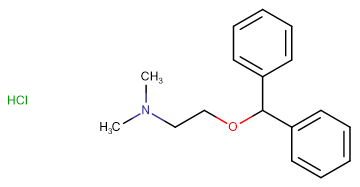
Diphenhydramine hydrochloride
CAS No. 147-24-0
Diphenhydramine hydrochloride( DPH )
Catalog No. M12021 CAS No. 147-24-0
Diphenhydramine HCl (Benadryl), a histamine H1 antagonist used as an antiemetic, antitussive.
Purity : >98% (HPLC)
 COA
Datasheet
HNMR
HPLC
MSDS
Handing Instructions
COA
Datasheet
HNMR
HPLC
MSDS
Handing Instructions
| Size | Price / USD | Stock | Quantity |
| 1 mL x 10 mM in DMSO | 42 | In Stock |


|
| 100MG | Get Quote | In Stock |
|
| 200MG | 27 | In Stock |
|
| 500MG | Get Quote | In Stock |
|
| 1G | Get Quote | In Stock |
|
Biological Information
-
Product NameDiphenhydramine hydrochloride
-
NoteResearch use only, not for human use.
-
Brief DescriptionDiphenhydramine HCl (Benadryl), a histamine H1 antagonist used as an antiemetic, antitussive.
-
DescriptionDiphenhydramine HCl (Benadryl), a histamine H1 antagonist used as an antiemetic, antitussive, for dermatoses and pruritus, for hypersensitivity reactions, as a hypnotic, an antiparkinson, and as an ingredient in common cold preparations.
-
In Vitro——
-
In Vivo——
-
SynonymsDPH
-
PathwayGPCR/G Protein
-
TargetHistamine Receptor
-
RecptorH1 receptor
-
Research AreaInflammation/Immunology
-
Indication——
Chemical Information
-
CAS Number147-24-0
-
Formula Weight291.82
-
Molecular FormulaC17H22ClNO
-
Purity>98% (HPLC)
-
SolubilityEthanol: 58 mg/mL (198.75 mM); Water: 58 mg/mL (198.75 mM); DMSO: 58 mg/mL (198.75 mM)
-
SMILESCl.CN(C)CCOC(C1=CC=CC=C1)C1=CC=CC=C1
-
Chemical Name——
Shipping & Storage Information
-
Storage(-20℃)
-
ShippingWith Ice Pack
-
Stability≥ 2 years
Reference
1.Piao H, et al. Vascul Pharmacol. 2007 Apr;46(4):260-70.
molnova catalog



related products
-
Metoprine
Metoprine is a potent inhibitor of histamine N-methyltransferase (HMT), with potential antineoplastic activity.In mammals, histamine N-methyltransferase (HMT) is the sole enzyme responsible for degrading histamine in the brain.
-
Pyrilamine maleate
A histamine H1 antagonist. It has mild hypnotic properties and some local anesthetic action and is used for allergies (including skin eruptions) both parenterally and locally.
-
Hydroxyzine free bas...
Hydroxyzine is an antagonist of histamine H1-receptor. Hydroxyzine is an antihistaminic with sedative properties used in the control of anxiety and emesis.
