


 Cart
Cart
 sales@molnova.com


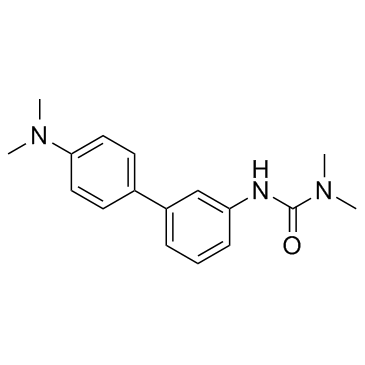
Atglistatin
CAS No. 1469924-27-3
Atglistatin( Atglistatin )
Catalog No. M12010 CAS No. 1469924-27-3
Atglistatin is a highly potent, selective and competitive inhibitor of adipose triglyceride lipase (ATGL) with an IC50 of ~0.7 μM for inhibition of lipolysis in vitro, but no toxicity up to a concentration of 50 μM.
Purity : >98% (HPLC)
 COA
Datasheet
HNMR
HPLC
MSDS
Handing Instructions
COA
Datasheet
HNMR
HPLC
MSDS
Handing Instructions
| Size | Price / USD | Stock | Quantity |
| 2MG | 31 | In Stock |


|
| 5MG | 50 | In Stock |
|
| 10MG | 95 | In Stock |
|
| 25MG | 178 | In Stock |
|
| 50MG | 332 | In Stock |
|
| 100MG | 525 | In Stock |
|
| 500MG | 1125 | In Stock |
|
| 1G | Get Quote | In Stock |
|
Biological Information
-
Product NameAtglistatin
-
NoteResearch use only, not for human use.
-
Brief DescriptionAtglistatin is a highly potent, selective and competitive inhibitor of adipose triglyceride lipase (ATGL) with an IC50 of ~0.7 μM for inhibition of lipolysis in vitro, but no toxicity up to a concentration of 50 μM.
-
DescriptionAtglistatin is a highly potent, selective and competitive inhibitor of adipose triglyceride lipase (ATGL) with an IC50 of ~0.7 μM for inhibition of lipolysis in vitro, but no toxicity up to a concentration of 50 μM.(In Vitro):Atglistatin inhibits Triacylglycerol (TG) hydrolase activity of wild-type white adipose tissue (WAT) in a dose-dependent manner up to 78% at the highest concentration. In comparison to wild-type preparations, TG hydrolase activity in WAT lysates from ATGL-ko animals is reduced by approximately 70% and Atglistatin had only a moderate effect on the residual activity. The combined use of Atglistatin and the hormone-sensitive lipase (HSL) inhibitor Hi 76-0079 leads to an almost complete inhibition (-95%) of TG hydrolase activity of WAT which implicates that most of the non-ATGL activity can be ascribed to HSL.(In Vivo):Animals receive Atglistatin dissolved in olive oil by oral gavage. After application, blood and tissues are collected for determination of plasma parameters, tissue Triacylglycerol (TG) levels, and inhibitor concentrations. Time-course experiments revealed that the lipolytic parameters fatty acids (FA) and glycerol are reduced 4 and 8 hours after application and returned to normal after 12 hours. Eight hours after treatment, a dose-dependent decrease is observed in FA and glycerol levels up to 50% and 62%, respectively. Atglistatin also caused a strong reduction in plasma TG levels (-43%) while blood glucose, total cholesterol, ketone bodies, and insulin levels do not significantly change. Dose and time-dependent inhibition of lipolysis is also observed in response to intraperitoneal injection of Atglistatin.
-
In Vitro——
-
In Vivo——
-
SynonymsAtglistatin
-
PathwayMetabolic Enzyme/Protease
-
TargetLipase
-
RecptorATGL
-
Research AreaMetabolic Disease
-
Indication——
Chemical Information
-
CAS Number1469924-27-3
-
Formula Weight283.37
-
Molecular FormulaC17H21N3O
-
Purity>98% (HPLC)
-
SolubilityEthanol: 4 mg/mL (14.11 mM); DMSO: 57 mg/mL (201.15 mM)
-
SMILESCN(C1=CC=C(C=C1)C2=CC(NC(N(C)C)=O)=CC=C2)C
-
Chemical Name3-(4'-(dimethylamino)-[1,1'-biphenyl]-3-yl)-1,1-dimethylurea
Shipping & Storage Information
-
Storage(-20℃)
-
ShippingWith Ice Pack
-
Stability≥ 2 years
Reference
1.Mayer N, et al. Nat Chem Biol. 2013, 9(12), 785-787.
molnova catalog



related products
-
JNJ-42226314
JNJ-42226314 is a highly selective non-covalent monoacylglycerol lipase (MAGL) inhibitor with anti-injury effects.
-
NG-497
NG-497 is a selective, small molecule inhibitor of human adipose triglyceride lipase (ATGL) that targets the enzymatically active patatin-like structural domain of human ATGL.
-
JZP-361
JZP-361 is a specific MAGL inhibitor with IC50s of 46 nM, 7.24 μM, and 1.79 μM for human recombinant MAGL, human recombinant FAAH, and human hABHD6.
