


 Cart
Cart
 sales@molnova.com


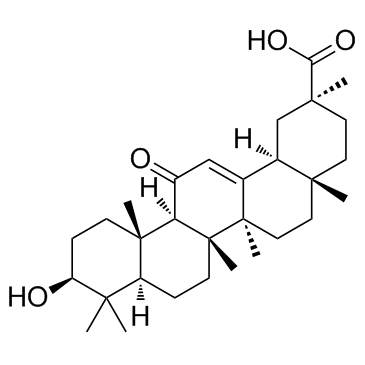
Glycyrrhetinic acid
CAS No. 1449-05-4
Glycyrrhetinic acid( (Enoxolone) )
Catalog No. M11928 CAS No. 1449-05-4
Enoxolone (INN, BAN; also known as glycyrrhetinic acid) is a pentacyclic triterpenoid derivative of the beta-amyrin type obtained from the hydrolysis of glycyrrhizic acid.
Purity : >98% (HPLC)
 COA
Datasheet
HNMR
HPLC
MSDS
Handing Instructions
COA
Datasheet
HNMR
HPLC
MSDS
Handing Instructions
| Size | Price / USD | Stock | Quantity |
| 1 mL x 10 mM in DMSO | 44 | In Stock |


|
| 25MG | 40 | In Stock |
|
| 50MG | 61 | In Stock |
|
| 100MG | Get Quote | In Stock |
|
| 200MG | Get Quote | In Stock |
|
| 500MG | Get Quote | In Stock |
|
| 1G | Get Quote | In Stock |
|
Biological Information
-
Product NameGlycyrrhetinic acid
-
NoteResearch use only, not for human use.
-
Brief DescriptionEnoxolone (INN, BAN; also known as glycyrrhetinic acid) is a pentacyclic triterpenoid derivative of the beta-amyrin type obtained from the hydrolysis of glycyrrhizic acid.
-
DescriptionEnoxolone (INN, BAN; also known as glycyrrhetinic acid) is a pentacyclic triterpenoid derivative of the beta-amyrin type obtained from the hydrolysis of glycyrrhizic acid, which was obtained from the herb liquorice. It is used in flavoring and it masks the bitter taste of drugs like aloe and quinine. It is effective in the treatment of peptic ulcer and also has expectorant (antitussive) properties.(In Vitro):18α-Glycyrrhetinic acid (18a-GA) markedly reduces LX-2 cell numbers by 14.8% and 31.2% after 48 h and 72 h of treatment, respectively (P< 0.05). 18α-Glycyrrhetinic acid also significantly increases the percentage of LX-2 cells in phase G0/G1 and decreases it in phase S after treated for 48 h and 72 h compare with the control group. 18α-Glycyrrhetinic acid increases apoptosis to 6.8% at 48 h, compare with control (2.5%), and at 72 h the percentages of apoptotic cells in control and the treatment groups are 3.1% and 15.6%, respectively, in LX-2 cells (P<0.01). Furthermore, 18α-Glycyrrhetinic acid induces expression of PPAR-γ and alters some cell cycle and apoptosis-related proteins. 18α-Glycyrrhetinic acid also inhibits NF-κB DNA-binding activity.(In Vivo):18α-Glycyrrhetinic acid (18α-GA) treatment significantly enhances life span of C. elegans strains with the most effective concentration being 20 μg/mL. Results reveal a significant delay of paralysis upon 18α-Glycyrrhetinic acid treatment. 18α-Glycyrrhetinic acid treatment also confers a significant reduction of Aβ deposits.
-
In Vitro18α-Glycyrrhetinic acid (18a-GA) markedly reduces LX-2 cell numbers by 14.8% and 31.2% after 48 h and 72 h of treatment, respectively (P< 0.05). 18α-Glycyrrhetinic acid also significantly increases the percentage of LX-2 cells in phase G0/G1 and decreases it in phase S after treated for 48 h and 72 h compare with the control group. 18α-Glycyrrhetinic acid increases apoptosis to 6.8% at 48 h, compare with control (2.5%), and at 72 h the percentages of apoptotic cells in control and the treatment groups are 3.1% and 15.6%, respectively, in LX-2 cells (P<0.01). Furthermore, 18α-Glycyrrhetinic acid induces expression of PPAR-γ and alters some cell cycle and apoptosis-related proteins. 18α-Glycyrrhetinic acid also inhibits NF-κB DNA-binding activity.
-
In Vivo18α-Glycyrrhetinic acid (18α-GA) treatmentsignificantly enhances life span of C. elegans strains with the most effective concentration being 20?μg/mL. Results reveal a significant delay of paralysis upon 18α-Glycyrrhetinic acid treatment. 18α-Glycyrrhetinic acid treatment also confers a significant reduction of Aβ deposits.
-
Synonyms(Enoxolone)
-
PathwayOthers
-
TargetOther Targets
-
RecptorOthers
-
Research AreaCancer
-
Indication——
Chemical Information
-
CAS Number1449-05-4
-
Formula Weight470.68
-
Molecular FormulaC30H46O4
-
Purity>98% (HPLC)
-
SolubilityDMSO: 10 mM
-
SMILESC[C@]12CC[C@](C[C@@H]1C3=CC(=O)[C@@H]4[C@]5(CC[C@@H](C([C@@H]5CC[C@]4([C@@]3(CC2)C)C)(C)C)O)C)(C)C(=O)O
-
Chemical Name——
Shipping & Storage Information
-
Storage(-20℃)
-
ShippingWith Ice Pack
-
Stability≥ 2 years
Reference
1.Parida PK, et al. Bioorg Med Chem Lett. 2014 Aug 15;24(16):3865-8.
molnova catalog



related products
-
Justicidin B
Justicidin B is a potent anticancer lignan and proapoptotic agent. Justicidin B is also a bone resorption inhibitor, and has strong antiviral, fungicidal, antiprotozoal effects.
-
Apigenin 7-O-(2G-rha...
Apigenin-7-O-(2G-rhamnosyl)gentiobioside is a flavone glycosides from Lonicera gracilipes var. glandulosa.
-
pep2-EVKI
Inhibitor peptide that selectively disrupts binding of the AMPA receptor subunit GluA2 (at the C-terminal PDZ site) to protein interacting with C kinase (PICK1). Does not affect binding of GluA2 to GRIP or ABP and does not increase AMPA current amplitude or affect long term depression (LTD).
