


 Cart
Cart
 sales@molnova.com


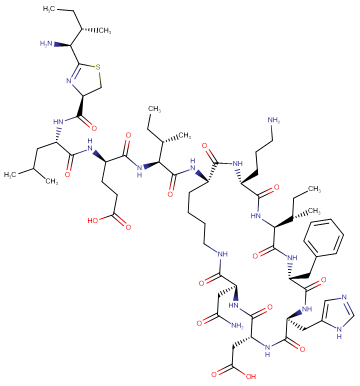
Bacitracin
CAS No. 1405-87-4
Bacitracin( Bacitracin )
Catalog No. M11703 CAS No. 1405-87-4
Bacitracin is a mixture of related cyclic polypeptides produced by organisms of the licheniformis group of Bacillus subtilis var Tracy.
Purity : >98% (HPLC)
 COA
Datasheet
HNMR
HPLC
MSDS
Handing Instructions
COA
Datasheet
HNMR
HPLC
MSDS
Handing Instructions
| Size | Price / USD | Stock | Quantity |
| 50MG | 28 | In Stock |


|
| 100MG | 37 | In Stock |
|
| 200MG | Get Quote | In Stock |
|
| 500MG | 75 | In Stock |
|
| 1G | 114 | In Stock |
|
Biological Information
-
Product NameBacitracin
-
NoteResearch use only, not for human use.
-
Brief DescriptionBacitracin is a mixture of related cyclic polypeptides produced by organisms of the licheniformis group of Bacillus subtilis var Tracy.
-
DescriptionBacitracin is a mixture of related cyclic polypeptides produced by organisms of the licheniformis group of Bacillus subtilis var Tracy, which disrupts both gram positive and gram negative bacteria by interfering with cell wall and peptidoglycan synthesis.(In Vitro):Bacitracin (64 μg/mL, 24 h) together with Colistin shows antibacterial activity against S. aureus BA01611.Bacitracin (64 μg/mL, 1 or 2 h) damages the cell surface to grape-like cell clusters, and the cell boundaries are faint and unclear.(In Vivo):Bacitracin (0-100 mg/kg, intramuscular injection, daily for 12 consecutive days) shows anti-tumor efficacy in HCC model.
-
In Vitro——
-
In VivoAnimal Model:HCC model (MH134 cells implanted)Dosage:0, 10, 50, and 100 mg/kg Administration:Intramuscular injection (i.m), daily for 12 consecutive days.Result:Decreased tumor volumes. Decreased the percentage of PDI-stained vascular densities.
-
SynonymsBacitracin
-
PathwayOthers
-
TargetOther Targets
-
RecptorOthers
-
Research AreaOther Indications
-
Indication——
Chemical Information
-
CAS Number1405-87-4
-
Formula Weight1422.73
-
Molecular FormulaC66H103N17O16S
-
Purity>98% (HPLC)
-
SolubilityWater: 100 mg/mL (70.98 mM); DMSO: 100 mg/mL (70.98 mM)
-
SMILESO=C(O)CC[C@@H](NC([C@@H](NC([C@H]1N=C([C@@H](N)[C@@H](C)CC)SC1)=O)CC(C)C)=O)C(N[C@@H]([C@@H](C)CC)C(N[C@@H]2C(N[C@H](CCCN)C(N[C@@H]([C@H](CC)C)C(N[C@H](CC3=CC=CC=C3)C(N[C@@H](CC4=CN=CN4)C(N[C@H](CC(O)=O)C(N[C@@H](CC(N)=O)C(NCCCC2)=O)=O)=O)=O)=O)=O)=O)=O)=O
-
Chemical Name(4R)-4-[[(2S)-2-[[(4R)-2-[(1S,2S)-1-amino-2-methylbutyl]-4,5-dihydro-1,3-thiazole-4-carbonyl]amino]-4-methylpentanoyl]amino]-5-[[(2S,3S)-1-[[(3S,6R,9S,12R,15S,18R,21S)-3-(2-amino-2-oxoethyl)-18-(3-aminopropyl)-12-benzyl-15-[(2S)-butan-2-yl]-6-(carboxymethyl)-9-(1H-imidazol-5-ylmethyl)-2,5,8,11,14,17,20-heptaoxo-1,4,7,10,13,16,19-heptazacyclopentacos-21-yl]amino]-3-methyl-1-oxopentan-2-yl]amino]-5-oxopentanoic acid
Shipping & Storage Information
-
Storage(-20℃)
-
ShippingWith Ice Pack
-
Stability≥ 2 years
Reference
1.Toscano WA Jr, et al. Pharmacol Ther, 1982, 16(2), 199-210.
molnova catalog



related products
-
TACE (ADAM-17)
TACE (ADAM-17)
-
Morusin
Morusin possesses antitumor effects of cell lines including HT-29, A549, MCF-7 and MDA-MB-231, through suppressing STAT3 and NFκB attenuation mediated apoptosis induction.
-
Sitagliptin Intermed...
Sitagliptin Intermediate 2 is a useful organic compound that has been used in life science related research.
