


 Cart
Cart
 sales@molnova.com


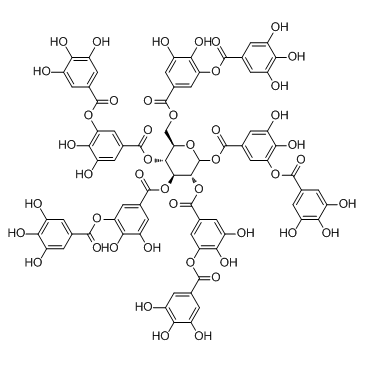
Glycerite
CAS No. 1401-55-4
Glycerite( Tannic acid | NSC 656273 | NSC-656273 )
Catalog No. M11675 CAS No. 1401-55-4
Polyphenolic compounds with molecular weights of around 500-3000 daltons and containing enough hydroxyl groups (1-2 per 100 MW) for effective cross linking of other compounds (ASTRINGENTS).
Purity : >98% (HPLC)
 COA
Datasheet
HNMR
HPLC
MSDS
Handing Instructions
COA
Datasheet
HNMR
HPLC
MSDS
Handing Instructions
| Size | Price / USD | Stock | Quantity |
| 100MG | Get Quote | In Stock |


|
| 200MG | Get Quote | In Stock |
|
| 500MG | Get Quote | In Stock |
|
| 1G | 29 | In Stock |
|
Biological Information
-
Product NameGlycerite
-
NoteResearch use only, not for human use.
-
Brief DescriptionPolyphenolic compounds with molecular weights of around 500-3000 daltons and containing enough hydroxyl groups (1-2 per 100 MW) for effective cross linking of other compounds (ASTRINGENTS).
-
DescriptionPolyphenolic compounds with molecular weights of around 500-3000 daltons and containing enough hydroxyl groups (1-2 per 100 MW) for effective cross linking of other compounds (ASTRINGENTS). The two main types are HYDROLYZABLE TANNINS and CONDENSED TANNINS. Historically, the term has applied to many compounds and plant extracts able to render skin COLLAGEN impervious to degradation. The word tannin derives from the Celtic word for OAK TREE which was used for leather processing. (In Vivo):During the course of treatment, tannic acid significantly ameliorates these phenotypes in AD skin lesions. Tannic acid treatment aslo reduces these dermal changes compare with AD mice. Treatment with tannic acid increases PPARγ expression in AD skin sections. The PPARγ protein expression is suppressed in vehicle-treated AD mice, but when treats with tannic acid, its expression is increased dramatically. The IL-1β, TNFα, TNFR1, and COX2 protein expressions are significantly up-regulated in vehicle-treated AD mice, but significantly suppressed by tannic acid treatment.
-
In Vitro——
-
In VivoDuring the course of treatment, tannic acid significantly ameliorates these phenotypes in AD skin lesions. Tannic acid treatment aslo reduces these dermal changes compare with AD mice. Treatment with tannic acid increases PPARγ expression in AD skin sections. The PPARγ protein expression is suppressed in vehicle-treated AD mice, but when treats with tannic acid, its expression is increased dramatically. The IL-1β, TNFα, TNFR1, and COX2 protein expressions are significantly up-regulated in vehicle-treated AD mice, but significantly suppressed by tannic acid treatment.
-
SynonymsTannic acid | NSC 656273 | NSC-656273
-
PathwayOthers
-
TargetOther Targets
-
RecptorOthers
-
Research Area——
-
Indication——
Chemical Information
-
CAS Number1401-55-4
-
Formula Weight1701.2
-
Molecular FormulaC76H52O46
-
Purity>98% (HPLC)
-
SolubilityDMSO: 10 mM
-
SMILESOC1=C(O)C(O)=CC(C(OC2=CC(C(OCC3C(OC(C4=CC(O)=C(O)C(OC(C5=CC(O)=C(O)C(O)=C5)=O)=C4)=O)C(OC(C6=CC(O)=C(O)C(OC(C7=CC(O)=C(O)C(O)=C7)=O)=C6)=O)C(OC(C8=CC(O)=C(O)C(OC(C9=CC(O)=C(O)C(O)=C9)=O)=C8)=O)C(OC(C%10=CC(O)=C(O)C(OC(C%11=CC(O)=C(O)C(O)=C%11)=O)=C%10)=O)O3)=O)=CC(O)=C2O)=O)=C1
-
Chemical Name6-(((3,4-dihydroxy-5-((3,4,5-trihydroxybenzoyl)oxy)benzoyl)oxy)methyl)tetrahydro-2H-pyran-2,3,4,5-tetrayl tetrakis(3,4-dihydroxy-5-((3,4,5-trihydroxybenzoyl)oxy)benzoate)
Shipping & Storage Information
-
Storage(-20℃)
-
ShippingWith Ice Pack
-
Stability≥ 2 years
Reference
1.JENKINS JT. Am J Surg. 1947 Oct;74(4):428-30.
molnova catalog



related products
-
Probimane
Probimane had Anti-proliferative effects, cell cycle G2/M phase arrest and blocking of chromosome segregation in human tumor cell lines with MST-16.
-
Ethyl chrysanthemuma...
Ethyl chrysanthemumate is an allelochemical compound used as an attractant.
-
BCMA72-80
BCMA72-80 is a HLA-A2-specific B-cell maturation antigen (BCMA) peptide, with a strong affinity to HLA-A2. It is used to used in the research of multiple myeloma or other B-cell maturation antigen expressing tumors.
