


 Cart
Cart
 sales@molnova.com


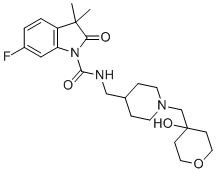
PF-03382792
CAS No. 1400811-63-3
PF-03382792( PF-3382792 )
Catalog No. M11670 CAS No. 1400811-63-3
PF-03382792 (PF-3382792) is a clinical compound under phase 1 investigation for an unknown indication.
Purity : >98% (HPLC)
 COA
Datasheet
HNMR
HPLC
MSDS
Handing Instructions
COA
Datasheet
HNMR
HPLC
MSDS
Handing Instructions
| Size | Price / USD | Stock | Quantity |
| 5MG | 239 | In Stock |


|
| 10MG | 341 | In Stock |
|
| 25MG | 511 | In Stock |
|
| 50MG | 703 | In Stock |
|
| 100MG | 918 | In Stock |
|
| 200MG | 1274 | In Stock |
|
| 500MG | Get Quote | In Stock |
|
| 1G | Get Quote | In Stock |
|
Biological Information
-
Product NamePF-03382792
-
NoteResearch use only, not for human use.
-
Brief DescriptionPF-03382792 (PF-3382792) is a clinical compound under phase 1 investigation for an unknown indication.
-
DescriptionPF-03382792 (PF-3382792) is a clinical compound under phase 1 investigation for an unknown indication.Other Indication Phase 1 Clinical.
-
In Vitro——
-
In Vivo——
-
SynonymsPF-3382792
-
PathwayOthers
-
TargetOther Targets
-
RecptorOther Targets
-
Research AreaOther Indications
-
IndicationOther Disease
Chemical Information
-
CAS Number1400811-63-3
-
Formula Weight433.52
-
Molecular FormulaC23H32FN3O4
-
Purity>98% (HPLC)
-
Solubility——
-
SMILESO=C(N1C(C(C)(C)C2=C1C=C(F)C=C2)=O)NCC3CCN(CC4(O)CCOCC4)CC3
-
Chemical Name1H-Indole-1-carboxamide, 6-fluoro-2,3-dihydro-3,3-dimethyl-2-oxo-N-((1-((tetrahydro-4-hydroxy-2H-pyran-4-yl)methyl)-4-piperidinyl)methyl)-
Shipping & Storage Information
-
Storage(-20℃)
-
ShippingWith Ice Pack
-
Stability≥ 2 years
Reference
molnova catalog



related products
-
RGB-1
RGB-1, a small molecule that selectively stabilizes the RNA G-quadruplex structure, enhances G-quadruplex-mediated inhibition of RNA translation in mammalian cells and reduces NRAS proto-oncogene expression in breast cancer cells.
-
Trepibutone
Trepibutone, an acidic drug, has the capability of pH-independent release.
-
(+/-)-Pinocembrin
(+/-)-Pinocembrin, a natural product from axillary pines, is a GPR120 ligand that promotes wound healing in the HaCaT cell line.
