


 Cart
Cart
 sales@molnova.com


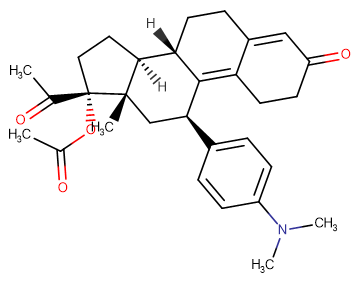
Ulipristal acetate
CAS No. 126784-99-4
Ulipristal acetate( CDB2914 )
Catalog No. M11121 CAS No. 126784-99-4
Ulipristal acetate(CDB2914) is a novel selective progesterone receptor modulator (SPRM) for the treatment of benign gynecological conditions such as uterine myoma.
Purity : >98% (HPLC)
 COA
Datasheet
HNMR
HPLC
MSDS
Handing Instructions
COA
Datasheet
HNMR
HPLC
MSDS
Handing Instructions
| Size | Price / USD | Stock | Quantity |
| 1 mL x 10 mM in DMSO | 48 | In Stock |


|
| 5MG | 43 | In Stock |
|
| 10MG | 58 | In Stock |
|
| 50MG | 117 | In Stock |
|
| 100MG | 184 | In Stock |
|
| 200MG | 276 | In Stock |
|
| 500MG | Get Quote | In Stock |
|
| 1G | Get Quote | In Stock |
|
Biological Information
-
Product NameUlipristal acetate
-
NoteResearch use only, not for human use.
-
Brief DescriptionUlipristal acetate(CDB2914) is a novel selective progesterone receptor modulator (SPRM) for the treatment of benign gynecological conditions such as uterine myoma.
-
DescriptionUlipristal acetate(CDB2914) is a novel selective progesterone receptor modulator (SPRM) for the treatment of benign gynecological conditions such as uterine myoma.(In Vitro):Ulipristal acetate (0.1-5 μM; 96 hours) stimulates autophagy in leiomyoma cells. Ulipristal-induced expression changes of the autophagic markers LC3 and p62/SQSTM1. Ulipristal up-regulates Atg7 protein in leiomyoma cells.Ulipristal acetate blocks activin A modulation of fibronectin and vascular endothelial growth factor A (VEGF-A) mRNA expression in cultured myometrial and leiomyoma cells.(In Vivo):Ulipristal and CDB-4124 have significant antiprogestational activity in vivo.Ulipristal acetate decreases incidences of fibroadenomas and adenocarcinomas in the mammary gland in all treated groups. Ulipristal acetate exposure [AUC(0-24h)] at the highest dose in rats is 67 times human therapeutic exposure at 10 mg/day. In mice, no tumor of any type increases at Ulipristal acetate exposures up to 313 times of therapeutic exposure. Ulipristal acetate-related findings in mice are limited to organ weight changes in the liver, pituitary, thyroid/parathyroid glands, and epididymis as well as minimal panlobular hepatocellular hypertrophy in male and female mice receiving 130 mg/kg/day.Ulipristal acetate (1 mg/kg and 5 mg/kg) increases the frequency with which pathologists assessed the endometrium as being thickened compared to controls in a dose-dependent manner. There is a slight decrease in secretory differentiation with increasing dose of Ulipristal acetate, with small decreases in frequency of sub- and supra-nuclear vacuolation.
-
In VitroUlipristal acetate (0.1-5 μM; 96 hours) stimulates autophagy in leiomyoma cells. Ulipristal-induced expression changes of the autophagic markers LC3 and p62/SQSTM1. Ulipristal up-regulates Atg7 protein in leiomyoma cells.Ulipristal acetate blocks activin A modulation of fibronectin and vascular endothelial growth factor A (VEGF-A) mRNA expression in cultured myometrial and leiomyoma cells.
-
In VivoUlipristal and CDB-4124 have significant antiprogestational activity in vivo. Ulipristal acetate decreases incidences of fibroadenomas and adenocarcinomas in the mammary gland in all treated groups. Ulipristal acetate exposure [AUC(0-24h)] at the highest dose in rats is 67 times human therapeutic exposure at 10 mg/day. In mice, no tumor of any type increases at Ulipristal acetate exposures up to 313 times of therapeutic exposure. Ulipristal acetate-related findings in mice are limited to organ weight changes in the liver, pituitary, thyroid/parathyroid glands, and epididymis as well as minimal panlobular hepatocellular hypertrophy in male and female mice receiving 130 mg/kg/day.Ulipristal acetate (1 mg/kg and 5 mg/kg) increases the frequency with which pathologists assessed the endometrium as being thickened compared to controls in a dose-dependent manner. There is a slight decrease in secretory differentiation with increasing dose of Ulipristal acetate, with small decreases in frequency of sub- and supra-nuclear vacuolation.
-
SynonymsCDB2914
-
PathwayEndocrinology/Hormones
-
TargetEstrogen Receptor/ERR
-
RecptorPR
-
Research AreaEndocrinology
-
Indication——
Chemical Information
-
CAS Number126784-99-4
-
Formula Weight475.62
-
Molecular FormulaC30H37NO4
-
Purity>98% (HPLC)
-
SolubilityDMSO: 10 mM
-
SMILESCC([C@@]1(OC(C)=O)CC[C@@]2([H])[C@]3([H])CCC4=CC(CCC4=C3[C@@H](C5=CC=C(N(C)C)C=C5)C[C@]12C)=O)=O
-
Chemical Name(8S,11R,13S,14S,17R)-17-acetyl-11-(4-(dimethylamino)phenyl)-13-methyl-3-oxo-2,3,6,7,8,11,12,13,14,15,16,17-dodecahydro-1H-cyclopenta[a]phenanthren-17-yl acetate
Shipping & Storage Information
-
Storage(-20℃)
-
ShippingWith Ice Pack
-
Stability≥ 2 years
Reference
1.Pohl O, et al. Int J Clin Pharmacol Ther. 2013 Jan;51(1):26-33.
molnova catalog



related products
-
LY88074
LY88074 is a raloxifene analog in which the basic side chain has been removed. LY88074 is an agonist of ERβ (EC50 = 232 nM).This compound stimulates uterine cell proliferation.
-
Megestrol acetate
Megestrol acetate is a progestogen with actions and uses similar to those of the progestogens in general.
-
Clomiphene citrate
A non-steroidal, a widely used fertility agent that inhibits estrogen receptor in the hypothalamus.
