


 Cart
Cart
 sales@molnova.com


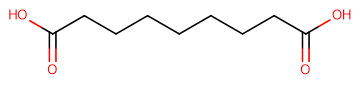
Azelaic acid
CAS No. 123-99-9
Azelaic acid( NSC 19493 )
Catalog No. M10969 CAS No. 123-99-9
Azelaic acid is a saturated dicarboxylic acid found naturally in wheat, rye, and barley.
Purity : >98% (HPLC)
 COA
Datasheet
HNMR
HPLC
MSDS
Handing Instructions
COA
Datasheet
HNMR
HPLC
MSDS
Handing Instructions
| Size | Price / USD | Stock | Quantity |
| 1 mL x 10 mM in DMSO | 28 | In Stock |


|
| 100MG | Get Quote | In Stock |
|
| 200MG | Get Quote | In Stock |
|
| 500MG | Get Quote | In Stock |
|
| 1G | 27 | In Stock |
|
Biological Information
-
Product NameAzelaic acid
-
NoteResearch use only, not for human use.
-
Brief DescriptionAzelaic acid is a saturated dicarboxylic acid found naturally in wheat, rye, and barley.
-
DescriptionAzelaic acid is a saturated dicarboxylic acid found naturally in wheat, rye, and barley. It is a natural substance that is produced by Malassezia furfur (also known as Pityrosporum ovale), a yeast that lives on normal skin. It is effective against a number of skin conditions, such as mild to moderate acne, when applied topically in a cream formulation of 20%. It works in part by stopping the growth of skin bacteria that cause acne, and by keeping skin pores clear. Azelaic acid's antimicrobial action may be attributable to inhibition of microbial cellular protein synthesis.
-
In VitroCell Viability AssayCell Line:Propionibacterium acnes and Staphylococcus epidermidis Concentration:0.5 M Incubation Time: Propionibacterium acnes for 48 h, Staphylococcus epidermidis for 7 D Result:Exhibited large reduction in viability (at least 40-fold) over 24 h.Immunofluorescence Cell Line:HL60, U937, THP-1, and AML-PC cells Concentration:5 M Incubation Time:24 hResult:Exhibited markedly decreasing the intracellular ROS levels.Cell Viability Assay Cell Line:B16, HMB2, and SK23, CHO Concentration: 10 nM, 20 nM, 30 nM, 40 nM, 50 nM, 60 nM, 70 nM, 80 nM, 90 nM, 100 nM Incubation Time: 24 h Result:Showed significantly reduce in the number of B16, HMB2, and SK23 comparing to CHO.
-
In VivoAnimal Model:Human with rosacea for 12 weeks Dosage:15% gel Administration:Smear Result:Showed excellent improvent in 78% of the patients with Azelaic acid.
-
SynonymsNSC 19493
-
PathwayCell Cycle/DNA Damage
-
TargetDNA/RNA Synthesis
-
RecptorDNA polymerase I| ThxR
-
Research Area——
-
Indication——
Chemical Information
-
CAS Number123-99-9
-
Formula Weight188.22
-
Molecular FormulaC9H16O4
-
Purity>98% (HPLC)
-
Solubilitysoluble in Water
-
SMILESOC(=O)CCCCCCCC(O)=O
-
Chemical Name——
Shipping & Storage Information
-
Storage(-20℃)
-
ShippingWith Ice Pack
-
Stability≥ 2 years
Reference
1.Stamatiadis D, et al. Br J Dermatol. 1988 Nov;119(5):627-32.
molnova catalog



related products
-
AS-136A
AS-136A is an orally active measles virus RNA-dependent RNA polymerase (RdRp) inhibitor with antiviral activity that inhibits measles virus and blocks viral RNA synthesis.
-
Dmt-2fluoro-da(bz) a...
Dmt-2'fluoro-da(bz) amidite is a 2'-deoxy-2'-fluoro-phosphorothioate oligonucleotide with high affinity and specificity for RNA targets and serves as an intermediate in the synthesis of 5'-DMT-3'-phosphoramidite, an antisense compound resistant to nuclease.
-
3-O-Acetyl-beta-bosw...
3-O-Acetyl-beta-boswellic acid has antitumor activity, it inhibits synthesis of DNA, RNA and protein in human leukemia HL-60 cells in a dose dependent manner with IC50 values ranging from 0.6 to 7.1 microM.
