


 Cart
Cart
 sales@molnova.com


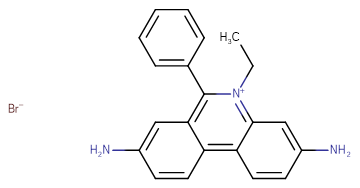
Ethidium bromide
CAS No. 1239-45-8
Ethidium bromide( —— )
Catalog No. M10965 CAS No. 1239-45-8
A trypanocidal agent and possible antiviral agent that is widely used in experimental cell biology and biochemistry.
Purity : >98% (HPLC)
 COA
Datasheet
HNMR
HPLC
MSDS
Handing Instructions
COA
Datasheet
HNMR
HPLC
MSDS
Handing Instructions
| Size | Price / USD | Stock | Quantity |
| 10MG | 57 | In Stock |


|
| 25MG | 102 | In Stock |
|
| 50MG | 144 | In Stock |
|
| 100MG | Get Quote | In Stock |
|
| 200MG | Get Quote | In Stock |
|
| 500MG | Get Quote | In Stock |
|
| 1G | Get Quote | In Stock |
|
Biological Information
-
Product NameEthidium bromide
-
NoteResearch use only, not for human use.
-
Brief DescriptionA trypanocidal agent and possible antiviral agent that is widely used in experimental cell biology and biochemistry.
-
DescriptionA trypanocidal agent and possible antiviral agent that is widely used in experimental cell biology and biochemistry. Ethidium has several experimentally useful properties including binding to nucleic acids, noncompetitive inhibition of nicotinic acetylcholine receptors, and fluorescence among others. It is most commonly used as the bromide. (In Vitro):Guidelines (Following is our recommended protocol. This protocol only provides a guideline, and should be modified according to your specific needs).The preparation of agarose gel:1. Agarose gels are commonly used in concentrations of 0.5% to 2.5% depending on the size of bands needed to be separated.2. Mix the agarose powder with 1X TAE/TBE.3. Microwave for 1-3 min until the agarose is completely dissolved (Caution: not overboil).4. Make the solution cool down before solidification.5. Add ethidium bromide (EtBr) to a final concentration of approximately 0.2-0.5 μg/mL (Stocks are generally 10 mg/ml, and require 5 μL stock/100 mL gel).6. Ethidium bromide binds to the DNA and you could visualize the DNA under ultraviolet (UV) light.CAUTION: EtBr is a known mutagen. Please pay attention to strengthening protection.
-
In VitroGuidelines (Following is our recommended protocol. This protocol only provides a guideline, and should be modified according to your specific needs). Agarose gels are commonly used in concentrations of 0.5% to 2.5% depending on the size of bands needed to be separated. Mix the agarose powder with 1X TAE/TBE. Microwave for 1-3 min until the agarose is completely dissolved (Caution: not overboil).?4. Make the solution cool down before solidification.Add ethidium bromide (EtBr) to a final concentration of approximately 0.2-0.5 μg/mL (Stocks are generally 10 mg/ml, and require 5 μL stock/100 mL gel).Ethidium bromide binds to the DNA and you could visualize the DNA under ultraviolet (UV) light.CAUTION: EtBr is a known mutagen. Please pay attention to strengthening protection.
-
In Vivo——
-
Synonyms——
-
PathwayOthers
-
TargetOther Targets
-
RecptorOthers
-
Research Area——
-
Indication——
Chemical Information
-
CAS Number1239-45-8
-
Formula Weight394.32
-
Molecular FormulaC21H20BrN3
-
Purity>98% (HPLC)
-
SolubilityDMSO: 10 mM
-
SMILES[Br-].CC[N+]1=C2C=C(N)C=CC2=C2C=CC(N)=CC2=C1C1=CC=CC=C1
-
Chemical Name——
Shipping & Storage Information
-
Storage(-20℃)
-
ShippingWith Ice Pack
-
Stability≥ 2 years
Reference
1.Diaz F, et al. Nucleic Acids Res. 2002 Nov 1;30(21):4626-33.
molnova catalog



related products
-
Endothelin-3, human,...
Endothelin-3, human, mouse, rabbit, rat , is a cyclic 21 amino acid peptide. It is an endogenous neuropeptide and potent vasoconstrictor.
-
DS-1040 tosylate hyd...
DS-1040 tosylate hydrate (DS1040) is a small molecule inhibitor of the activated thrombin-activatable fibrinolysis inhibitor (TAFIa) with IC50 of 1.7 ng/mL for rabbit TAFIa.
-
Aloveroside A
Aloveroside A is a triglucosylnaphthalene derivative isolated from ethanolic extract of aloe vera. Aloveroside A has weak bACE inhibitory activity (inhibition rate at a dose of 100 μg/mL is approximately 18.68%).
