


 Cart
Cart
 sales@molnova.com


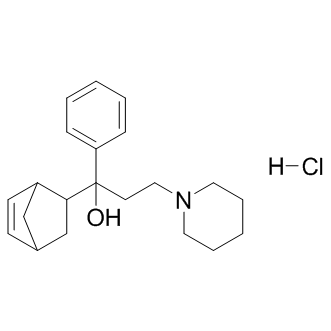
Biperiden hydrochloride
CAS No. 1235-82-1
Biperiden hydrochloride( NSC 170950 | NSC 84989 )
Catalog No. M10948 CAS No. 1235-82-1
Biperiden Hcl (NSC 170950, NSC 84989) is a centrally-acting antiparkinsonian agent that functions as a selective central M1 cholinoreceptors blocker.
Purity : >98% (HPLC)
 COA
Datasheet
HNMR
HPLC
MSDS
Handing Instructions
COA
Datasheet
HNMR
HPLC
MSDS
Handing Instructions
| Size | Price / USD | Stock | Quantity |
| 100MG | Get Quote | Get Quote |


|
| 200MG | Get Quote | Get Quote |
|
| 500MG | Get Quote | Get Quote |
|
| 1G | Get Quote | Get Quote |
|
Biological Information
-
Product NameBiperiden hydrochloride
-
NoteResearch use only, not for human use.
-
Brief DescriptionBiperiden Hcl (NSC 170950, NSC 84989) is a centrally-acting antiparkinsonian agent that functions as a selective central M1 cholinoreceptors blocker.
-
DescriptionBiperiden Hcl (NSC 170950, NSC 84989) is a centrally-acting antiparkinsonian agent that functions as a selective central M1 cholinoreceptors blocker.Parkinson Disease Approved.
-
In VitroBiperiden hydrochloride (29.6 μg/ml, 72 hours) can significantly induce apoptosis and inhibit proliferation at high doses in human pancreatic ductal adenocarcinoma cells. Cell Proliferation Assay Cell Line:Panc-1, Panc-2 and BxPC3 human pancreatic ductal adenocarcinoma cells Concentration:29.6 μg/mL Incubation Time:72 hours Result:Inhibited cell proliferation at 72 hours significantly by reducing nuclear c-Rel translocation.
-
In VivoBiperiden hydrochloride (intraperitoneal injection, 10 mg/kg, everyday, 3 weeks) reduces tumor size by 83% in subcutaneous xenograft mouse using Panc-1 human pancreatic ductal adenocarcinoma cells. Biperiden hydrochloride (intraperitoneal injection, 8 mg/kg, every 8 hours, 10 days) can reduce frequency of spontaneous seizures and extracellular hippocampal glutamate levels while cause a long-term decrease in hippocampal excitability. Animal Model:Subcutaneous xenograft mouse using Panc-1 human pancreatic ductal adenocarcinoma cells Dosage:10 mg/kg Administration:Intraperitoneal injection; everyday; 3 weeks Result:Tumor size reduced by 83%.Animal Model:Male Wistar rats (200-250 g) Dosage:8 mg/kg Administration: Intraperitoneal injection; every 8 hours; 10 days Result:Reduced late seizures by about three times with no affecting emotional memory damage.
-
SynonymsNSC 170950 | NSC 84989
-
PathwayGPCR/G Protein
-
TargetmAChR
-
RecptormAChR
-
Research AreaNeurological Disease
-
IndicationParkinson Disease
Chemical Information
-
CAS Number1235-82-1
-
Formula Weight347.922
-
Molecular FormulaC21H30ClNO
-
Purity>98% (HPLC)
-
Solubility10 mM in DMSO
-
SMILESC1CCN(CC1)CCC(C2CC3CC2C=C3)(C4=CC=CC=C4)O.Cl
-
Chemical Name1-Piperidinepropanol, .alpha.-bicyclo[2.2.1]hept-5-en-2-yl-.alpha.-phenyl-, hydrochloride (1:1)
Shipping & Storage Information
-
Storage(-20℃)
-
ShippingWith Ice Pack
-
Stability≥ 2 years
Reference
1. Pehl C, et al. Aliment Pharmacol Ther. 1998 Oct;12(10):979-84.
2. Kornhuber J, et al. PLoS One. 2011;6(8):e23852.
3. Gieling E, et al. Behav Brain Funct. 2013 Jan 10;9:4.
molnova catalog



related products
-
Pirmenol hydrochlori...
An orally effective, long-acting antiarrhythmic agent that interacts with cardiac muscarinic receptors.
-
Batefenterol
A bifunctional M3 mAChR antagonist and β2-adrenoceptor agonist (MABA) with pKi/pEC50 of 8.7/9.6 for hM3/hβ2 respectively.
-
Fesoterodine maleate
Fesoterodine (PF-00695838) is a competitive muscarinic receptor antagonist with muscle relaxant and urinary antispasmodic properties.
