


 Cart
Cart
 sales@molnova.com


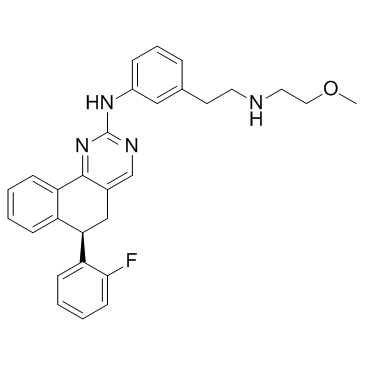
Derazantinib
CAS No. 1234356-69-4
Derazantinib( ARQ-087 | ARQ087 )
Catalog No. M10930 CAS No. 1234356-69-4
Derazantinib (ARQ-087) is a novel potent, ATP competitive multi-kinase inhibitor with IC50 of FGFR1/2/3 with IC50 of 1.8-4.5 nM.
Purity : >98% (HPLC)
 COA
Datasheet
HNMR
HPLC
MSDS
Handing Instructions
COA
Datasheet
HNMR
HPLC
MSDS
Handing Instructions
| Size | Price / USD | Stock | Quantity |
| 1 mL x 10 mM in DMSO | 121 | In Stock |


|
| 5MG | 112 | In Stock |
|
| 10MG | 163 | In Stock |
|
| 25MG | 272 | In Stock |
|
| 50MG | 393 | In Stock |
|
| 100MG | 585 | In Stock |
|
| 200MG | 832 | In Stock |
|
| 500MG | Get Quote | In Stock |
|
| 1G | Get Quote | In Stock |
|
Biological Information
-
Product NameDerazantinib
-
NoteResearch use only, not for human use.
-
Brief DescriptionDerazantinib (ARQ-087) is a novel potent, ATP competitive multi-kinase inhibitor with IC50 of FGFR1/2/3 with IC50 of 1.8-4.5 nM.
-
DescriptionDerazantinib (ARQ-087) is a novel potent, ATP competitive multi-kinase inhibitor with IC50 of FGFR1/2/3 with IC50 of 1.8-4.5 nM; also inhibits FGFR4, Src, Abl, RET, etc. (IC50<50 nM); inhibits FGFR2 auto-phosphorylation and other proteins downstream in the FGFR pathway (FRS2α, AKT, ERK), shows potent anti-proliferative effect in cell lines driven by FGFR dysregulation; shows tumor growth inhibition in vivo in xenograft tumor models.Liver Cancer Phase 3 Clinical(In Vitro):In cells, inhibition of FGFR2 auto-phosphorylation and other proteins downstream in the FGFR pathway (FRS2α, AKT, ERK) is evident by the response to Derazantinib treatment. Cell proliferation studies demonstrate Derazantinib has anti-proliferative activity in cell lines driven by FGFR dysregulation, including amplifications, fusions, and mutations. Cell cycle studies in cell lines with high levels of FGFR2 protein show a positive relationship between Derazantinib induced G1 cell cycle arrest and subsequent induction of apoptosis. Derazantinib rescues the FGF2-mediated growth arrest with EC50 at about 100 nM, with no significant toxicity detected for up to 500 nM. The concentration range at which Derazantinib significantly suppresses the FGF2 effect is between 70-500 nM. Derazantinib inhibits FGF-mediated loss of extracellular matrix and induction of chondrocyte premature senescence. Derazantinib rescues FGF-mediated inhibition of chondrocyte differentiation in tibia cultures. Derazantinib inhibits FGFR1-4 but no other receptor tyrosine kinases in cell-free kinase assay. Derazantinib inhibits FGFR1 and FGFR2 mutants associated with craniosynostoses. Derazantinib rescues FGFR-mediated bone differentiation in mouse limb bud micromass cultures and ex vivo mouse calvarial organ cultures.(In Vivo):Derazantinib is effective at inhibiting tumor growth in FGFR2 altered, SNU-16 and NCI-H716, xenograft tumor models with gene amplifications and fusions. Most of the embryos exhibit abnormal external phenotype (81.3%) in Derazantinib-injected wings, possibly due to inhibition of proliferation of limb bud mesenchyme. The wings are shorter and thinner, with skeletal phenotype typical for FGFR inhibition, where ulna and radius are shorter or smaller in size, or occasionally missing completely.
-
In VitroIn cells, inhibition of FGFR2 auto-phosphorylation and other proteins downstream in the FGFR pathway (FRS2α, AKT, ERK) is evident by the response to Derazantinib treatment. Cell proliferation studies demonstrate Derazantinib has anti-proliferative activity in cell lines driven by FGFR dysregulation, including amplifications, fusions, and mutations. Cell cycle studies in cell lines with high levels of FGFR2 protein show a positive relationship between Derazantinib induced G1 cell cycle arrest and subsequent induction of apoptosis. Derazantinib rescues the FGF2-mediated growth arrest with EC50 at about 100 nM, with no significant toxicity detected for up to 500 nM. The concentration range at which Derazantinib significantly suppresses the FGF2 effect is between 70-500 nM. Derazantinib inhibits FGF-mediated loss of extracellular matrix and induction of chondrocyte premature senescence. Derazantinib rescues FGF-mediated inhibition of chondrocyte differentiation in tibia cultures. Derazantinib inhibits FGFR1-4 but no other receptor tyrosine kinases in cell-free kinase assay. Derazantinib inhibits FGFR1 and FGFR2 mutants associated with craniosynostoses. Derazantinib rescues FGFR-mediated bone differentiation in mouse limb bud micromass cultures and ex vivo mouse calvarial organ cultures.
-
In VivoDerazantinib is effective at inhibiting tumor growth in FGFR2 altered, SNU-16 and NCI-H716, xenograft tumor models with gene amplifications and fusions. Most of the embryos exhibit abnormal external phenotype (81.3%) in Derazantinib-injected wings, possibly due to inhibition of proliferation of limb bud mesenchyme. The wings are shorter and thinner, with skeletal phenotype typical for FGFR inhibition, where ulna and radius are shorter or smaller in size, or occasionally missing completely.
-
SynonymsARQ-087 | ARQ087
-
PathwayAngiogenesis
-
TargetFGFR
-
RecptorFGFR
-
Research AreaCancer
-
IndicationLiver Cancer
Chemical Information
-
CAS Number1234356-69-4
-
Formula Weight468.576
-
Molecular FormulaC29H29FN4O
-
Purity>98% (HPLC)
-
Solubility10 mM in DMSO
-
SMILESCOCCNCCC1=CC(NC2=NC=C3C[C@@H](C4=CC=CC=C4F)C5=CC=CC=C5C3=N2)=CC=C1
-
Chemical Name(6R)-6-(2-fluorophenyl)-N-(3-{2-[(2-methoxyethyl)amino]ethyl}phenyl)-5,6-dihydrobenzo[h]quinazolin-2-amine
Shipping & Storage Information
-
Storage(-20℃)
-
ShippingWith Ice Pack
-
Stability≥ 2 years
Reference
1. Hall TG, et al. PLoS One. 2016 Sep 14;11(9):e0162594.
2. Yu Y, et al. Anticancer Drugs. 2017 Jun;28(5):503-513.
3. Balek L, et al. Bone. 2017 Dec;105:57-66.
4. Papadopoulos KP, et al. Br J Cancer. 2017 Nov 21;117(11):1592-1599.
molnova catalog



related products
-
Dovitinib
A novel, multitargeted RTK inhibitor of class III, IV, and V RTKs.
-
SU4984
SU4984 is a cell-permeable, ATP-competitive and reversible inhibitor of the fibroblast growth factor receptor 1 (FGFR1).
-
GSK2830371
GSK2830371 is an orally active, allosteric Wip1 phosphatase inhibitor with IC50 of 6 nM.
