


 Cart
Cart
 sales@molnova.com


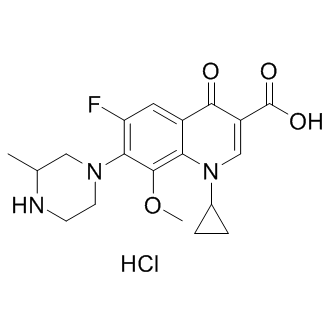
Gatifloxacin hydrochloride
CAS No. 121577-32-0
Gatifloxacin hydrochloride( AM 1155 hydrochloride | BMS 206584-01 hydrochloride | PD 135432 hydrochloride )
Catalog No. M10807 CAS No. 121577-32-0
A fourth-generation fluoroquinolone antibiotic that inhibits the bacterial DNA gyrase and topoisomerase IV.
Purity : >98% (HPLC)
 COA
Datasheet
HNMR
HPLC
MSDS
Handing Instructions
COA
Datasheet
HNMR
HPLC
MSDS
Handing Instructions
| Size | Price / USD | Stock | Quantity |
| 100MG | Get Quote | In Stock |


|
| 200MG | Get Quote | In Stock |
|
| 500MG | Get Quote | In Stock |
|
| 1G | 32 | In Stock |
|
Biological Information
-
Product NameGatifloxacin hydrochloride
-
NoteResearch use only, not for human use.
-
Brief DescriptionA fourth-generation fluoroquinolone antibiotic that inhibits the bacterial DNA gyrase and topoisomerase IV.
-
DescriptionA fourth-generation fluoroquinolone antibiotic that inhibits the bacterial DNA gyrase and topoisomerase IV; displays 2- to 16-fold more active than ciprofloxacin and ofloxacin against Staphylococcus aureus with MICs of 0.1-0.78 ug/mL.(In Vitro):Gatifloxacin hydrochloride is against S. aureus MS5935 topoisomerase IV, E. coli NIHJ JC-2 DNA gyrase and HeLa cell topoisomerase II with IC50 values of 13.8 μg/ml, 0.109 μg/ml, and 265 μg/ml, respectively.Gatifloxacin hydrochloride is against S. aureus MS5935 topoisomerase IV, E. coli NIHJ JC-2 DNA gyrase and HeLa cell topoisomerase II with MIC values of 0.05 μg/ml, 0.0063 μg/ml, and 122 μg/ml, respectively.Gatifloxacin hydrochloride exhibits antibacterial activities for wild-type strains (MS5935, MS5952, MR5867 and MR6009) the first-, second-, third-, and fourth-step mutants with MIC values of 0.05 to 0.10 μg/ml, 0.20 μg/ml, 1.56 to 3.13 μg/ml, 1.56 to 6.25 μg/ml, and 50 to 200 μg/ml, respectively. Gatifloxacin hydrochloride displays the most potent activity against the second- and third-step mutants (MS5952, MR5867 and MR6009) except for the second-step mutant of strain MS5935.Gatifloxacin hydrochloride has potent activity against norA transformant NY12 (MIC, 0.39 μg/ml).Gatifloxacin hydrochloride (20-100 μM; 72 hours) significantly decreases insulin content to 60% at Day 1, and continues to be reduced to 50.1% and 44.7% at Day 3 by 20 μM and 100 μM Gatifloxacin hydrochloride, respectively.(In Vivo):Gatifloxacin hydrochloride (subcutaneous injection; 100 mg/kg; 3 times a day; 30 days) significantly decreases the number of lesions in mouse footpad with Nocardia brasiliensis.
-
In VitroGatifloxacin hydrochloride is against S. aureus?MS5935 topoisomerase IV, E. coli?NIHJ JC-2 DNA gyrase and HeLa cell topoisomerase II with IC50 values of 13.8 μg/ml, 0.109 μg/ml, and 265 μg/ml, respectively.Gatifloxacin hydrochloride is against S. aureus?MS5935 topoisomerase IV, E. coli?NIHJ JC-2 DNA gyrase and HeLa cell topoisomerase II with MIC values of 0.05 μg/ml, 0.0063 μg/ml, and 122 μg/ml, respectively.Gatifloxacin hydrochloride exhibits antibacterial activities for wild-type strains (MS5935, MS5952, MR5867 and MR6009) the first-, second-, third-, and fourth-step mutants with MIC values of 0.05 to 0.10 μg/ml, 0.20 μg/ml, 1.56 to 3.13 μg/ml, 1.56 to 6.25 μg/ml, and 50 to 200 μg/ml, respectively. Gatifloxacin hydrochloride displays the most potent activity against the second- and third-step mutants (MS5952, MR5867 and MR6009) except for the second-step mutant of strain MS5935.Gatifloxacin hydrochloride has potent activity against norA transformant NY12 (MIC, 0.39 μg/ml).Gatifloxacin hydrochloride (20-100 μM; 72 hours) significantly decreases insulin content to 60% at Day 1, and continues to be reduced to 50.1% and 44.7% at Day 3 by 20 μM and 100 μM Gatifloxacin hydrochloride, respectively.
-
In VivoGatifloxacin hydrochloride (subcutaneous injection; 100 mg/kg; 3 times a day; 30 days) significantly decreases the number of lesions inmouse footpad with Nocardia brasiliensis. Animal Model:Female BALB/c mice with Nocardia brasiliensis in the right hind footpad Dosage:100 mg/kg Administration:Subcutaneous injection; 3 times a day; 30 days Result:Reduced the production of lesions in mice.
-
SynonymsAM 1155 hydrochloride | BMS 206584-01 hydrochloride | PD 135432 hydrochloride
-
PathwayGPCR/G Protein
-
TargetAntibacterial
-
RecptorAntibacterial
-
Research AreaInfection
-
Indication——
Chemical Information
-
CAS Number121577-32-0
-
Formula Weight411.855
-
Molecular FormulaC19H23ClFN3O4
-
Purity>98% (HPLC)
-
Solubility10 mM in DMSO
-
SMILESCC1CN(CCN1)C2=C(C=C3C(=C2OC)N(C=C(C3=O)C(=O)O)C4CC4)F.Cl
-
Chemical Name3-Quinolinecarboxylic acid, 1-cyclopropyl-6-fluoro-1,4-dihydro-8-methoxy-7-(3-methyl-1-piperazinyl)-4-oxo-, hydrochloride (1:1)
Shipping & Storage Information
-
Storage(-20℃)
-
ShippingWith Ice Pack
-
Stability≥ 2 years
Reference
1. Hosaka M, et al. Antimicrob Agents Chemother. 1992 Oct;36(10):2108-17.
2. Tomioka H, et al. Antimicrob Agents Chemother. 1993 Jun;37(6):1259-63.
3. Wakabayashi E, et al. Antimicrob Agents Chemother. 1994 Mar;38(3):594-601.
molnova catalog



related products
-
LL-37, Human
LL-37, Human is a 37-residue, amphipathic, cathelicidin-derived antimicrobial peptide, which exhibits a broad spectrum of antimicrobial activity.
-
Besifloxacin hydroch...
A fourth-generation fluoroquinolone antibiotic that exhibits a broad spectrum in vitro activity against a wide range of Gram-positive and Gram-negative ocular pathogens.
-
Ampicillin
Ampicillin is an orally active broad-spectrum antibiotic.
