


 Cart
Cart
 sales@molnova.com


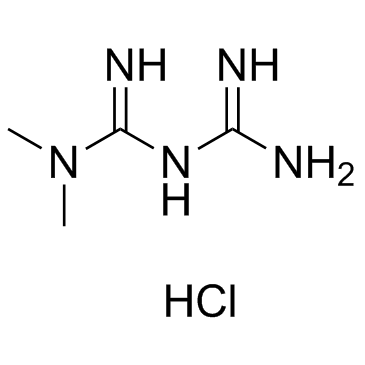
Metformin hydrochloride
CAS No. 1115-70-4
Metformin hydrochloride( 1,1-Dimethylbiguanide hydrochloride )
Catalog No. M10423 CAS No. 1115-70-4
Metformin Hcl, a widely used anti-diabetic drug has potential efficacy as an anti-Y drug.
Purity : >98% (HPLC)
 COA
Datasheet
HNMR
HPLC
MSDS
Handing Instructions
COA
Datasheet
HNMR
HPLC
MSDS
Handing Instructions
| Size | Price / USD | Stock | Quantity |
| 100MG | 31 | In Stock |


|
| 200MG | Get Quote | In Stock |
|
| 500MG | 72 | In Stock |
|
| 1G | 91 | In Stock |
|
Biological Information
-
Product NameMetformin hydrochloride
-
NoteResearch use only, not for human use.
-
Brief DescriptionMetformin Hcl, a widely used anti-diabetic drug has potential efficacy as an anti-Y drug.
-
DescriptionMetformin Hcl, a widely used anti-diabetic drug has potential efficacy as an anti-Y drug. Metformin inhibits the proliferation of a range of Y cells including prostate, colon, breast, ovarian, and glioma lines.(In Vitro):Metformin hydrochloride (1,1-Dimethylbiguanide hydrochloride) inhibits proliferation of ESCs in a concentration-dependent manner. The IC50 is 2.45 mM for A-ESCs and 7.87 mM for N-ESCs. Metformin shows pronounced effects on activation of AMPK signaling in A-ESCs from secretory phase than in cells from proliferative phase.Metformin hydrochloride (0-500 μM) decreases glycogen synthesis in a dose-dependent manner with an IC50 value of 196.5 μM in cultured rat hepatocytes.Metformin hydrochloride shows cell viability and cytotoxic effects on PC-3 cells with IC50 of 5 mM.(In Vivo):Metformin hydrochloride (1,1-Dimethylbiguanide hydrochloride; 100 mg/kg, p.o.) alone, and metformin (25, 50, 100 mg/kg) with NSC 37745 groups attenuates myocyte necrosis through histopathological analysis.
-
In VitroMetformin hydrochloride (1,1-Dimethylbiguanide hydrochloride) inhibits proliferation of ESCs in a concentration-dependent manner. The IC50 is 2.45?mM for A-ESCs and 7.87?mM for N-ESCs. Metformin shows pronounced effects on activation of AMPK signaling in A-ESCs from secretory phase than in cells from proliferative phase. Metformin hydrochloride (0-500 μM) decreases glycogen synthesis in a dose-dependent manner with an IC50 value of 196.5 μM in cultured rat hepatocytes.Metformin hydrochloride shows cell viability and cytotoxic effects on PC-3 cells with IC50 of 5 mM.
-
In VivoMetformin hydrochloride (1,1-Dimethylbiguanide hydrochloride; 100 mg/kg, p.o.) alone, and metformin (25, 50, 100 mg/kg) with NSC 37745 groups attenuates myocyte necrosis through histopathological analysis.
-
Synonyms1,1-Dimethylbiguanide hydrochloride
-
PathwayMembrane Transporter/Ion Channel
-
TargetAMPK
-
RecptorAMPK
-
Research AreaCancer
-
Indication——
Chemical Information
-
CAS Number1115-70-4
-
Formula Weight165.63
-
Molecular FormulaC4H12ClN5
-
Purity>98% (HPLC)
-
SolubilityWater: 33 mg/mL warmed (199.25 mM)
-
SMILESCl.CN(C)C(=N)N=C(N)N
-
Chemical Name——
Shipping & Storage Information
-
Storage(-20℃)
-
ShippingWith Ice Pack
-
Stability≥ 2 years
Reference
1.Kovacic S, et al. J Biol Chem. 2003 Oct 10;278(41):39422-7. Epub 2003 Jul 29.
molnova catalog



related products
-
YLF-466D
YLF-466D (C24) is a novel AMPK activator that inhibits platelet aggregation.
-
GSK621
GSK621 (GSK-621) is a potent, specific AMPK agonist (activator), induces cytotoxicity in AML (IC50=13-30 uM).
-
MT 63-78
MT 63-78 is a specific and effective direct AMPK activator (EC50: 25 μM). MT 63-78 blocks prostate cancer growth by inhibiting the lipogenesis and mTORC1 pathways.
