


 Cart
Cart
 sales@molnova.com


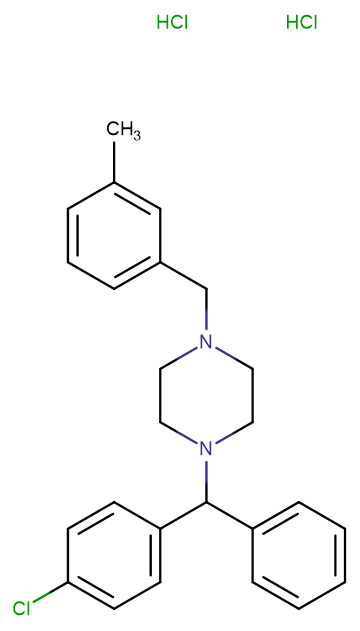
Meclizine dihydrochloride
CAS No. 1104-22-9
Meclizine dihydrochloride( NSC 28728 )
Catalog No. M10399 CAS No. 1104-22-9
Meclizine is a histamine H1 receptor antagonist used to treat nausea and motion sickness, has anti-histamine, anti-muscarinic and anti-oxidative phosphorylation properties.
Purity : >98% (HPLC)
 COA
Datasheet
HNMR
HPLC
MSDS
Handing Instructions
COA
Datasheet
HNMR
HPLC
MSDS
Handing Instructions
| Size | Price / USD | Stock | Quantity |
| 100MG | 47 | In Stock |


|
| 200MG | Get Quote | In Stock |
|
| 500MG | Get Quote | In Stock |
|
| 1G | Get Quote | In Stock |
|
Biological Information
-
Product NameMeclizine dihydrochloride
-
NoteResearch use only, not for human use.
-
Brief DescriptionMeclizine is a histamine H1 receptor antagonist used to treat nausea and motion sickness, has anti-histamine, anti-muscarinic and anti-oxidative phosphorylation properties.
-
DescriptionMeclizine is a histamine H1 receptor antagonist used to treat nausea and motion sickness, has anti-histamine, anti-muscarinic and anti-oxidative phosphorylation properties, also an agonist ligand for mCAR (constitutive androstane receptor) and an inverse agonist for hCAR.(In Vitro):Meclizine (Meclozine; 50 μM; 24 hours) dihydrochloride significantly increases cell survival in STHdhQ111/111 cells at 24 h after the removal of serum, evidently by suppressing apoptosis, based on caspase 3 and 7 cleavage. The rescue is dose-dependent with an EC50 of 17.3 μm, and a maximum efficacy of 218% increased survival over vehicle. Meclizine dihydrochloride protects striatal cells expressing polyglutamine (polyQ)-expanded huntingtin from serum withdrawal-induced apoptosis of mutant (STHdhQ111/111) and wild-type (STHdhQ7/7) striatal cells.(In Vivo):Meclizine (Meclozine; 10-100 mg/kg; ip) dihydrochloride protects mouse against kidney ischemia. Pretreatment with 100 mg/kg of Meclizine, 17 or 24 h prior to ischemia shows kidney protection in mice. Meclizine dihydrochloride reduces mitochondrial oxygen consumption by directly inhibiting the Kennedy pathway of phosphatidylethanolamine biosynthesis and up-regulated glycolysis.
-
In VitroMeclizine (Meclozine; 50 μM; 24 hours) dihydrochloride significantly increases cell survival in STHdhQ111/111 cells at 24 h after the removal of serum, evidently by suppressing apoptosis, based on caspase 3 and 7 cleavage. The rescue is dose-dependent with an EC50 of 17.3 μm, and a maximum efficacy of 218% increased survival over vehicle. Meclizine dihydrochloride protects striatal cells expressing polyglutamine (polyQ)-expanded huntingtin from serum withdrawal-induced apoptosis of mutant (STHdhQ111/111) and wild-type (STHdhQ7/7) striatal cells. Cell Viability Assay Cell Line:The murine striatal cells expressing wild-type (STHdhQ7/7) or mutant (STHdhQ111/111) huntingtin protein Concentration:50 μMIncubation Time:24 hours Result:Significantly increased cell survival in STHdhQ111/111 cells at 24 h after the removal of serum. Western Blot Analysis Cell Line:Mutant (STHdhQ111/111) and wild-type (STHdhQ7/7) striatal cells.
-
In VivoMeclizine (Meclozine; 10-100 mg/kg; ip) dihydrochloride protects mouse against kidney ischemia. Pretreatment with 100 mg/kg of Meclizine, 17 or 24 h prior to ischemia shows kidney protection in mice. Meclizine dihydrochloride reduces mitochondrial oxygen consumption by directly inhibiting the Kennedy pathway of phosphatidylethanolamine biosynthesis and up-regulated glycolysis. Animal Model:8-10 wk old male C57BL/6 mice Dosage:10, 30, 60 or 100 mg/kg Administration:Administered intraperitoneally Result:Protected mice from kidney ischemia-reperfusion injury.
-
SynonymsNSC 28728
-
PathwayGPCR/G Protein
-
TargetHistamine Receptor
-
RecptorH1 receptor
-
Research AreaNeurological Disease
-
Indication——
Chemical Information
-
CAS Number1104-22-9
-
Formula Weight463.87
-
Molecular FormulaC25H27ClN2·2HCl
-
Purity>98% (HPLC)
-
SolubilityDMSO: 1 mg/mL (2.15 mM)
-
SMILESCl.Cl.CC1=CC(CN2CCN(CC2)C(C2=CC=CC=C2)C2=CC=C(Cl)C=C2)=CC=C1
-
Chemical Name——
Shipping & Storage Information
-
Storage(-20℃)
-
ShippingWith Ice Pack
-
Stability≥ 2 years
Reference
1.King CT, et al. J Pharmacol Exp Ther, 1965, 147, 391-398.
molnova catalog



related products
-
JNJ-18038683
JNJ-18038683 is a potent, selective 5-HT7 receptor antagonist with pKi of 8.19 and 8.20 for rat and human 5-HT7 in cell-based assays; decreases 5-HT (100 nM)-stimulated adenylyl cyclase in rat and human 5-HT7/HEK293 cells with pKb of 8.01 and 7.99, respectively.
-
Clobenpropit dihydro...
Clobenpropit dihydrobromide is a potent ?antagonist and inverse agonist of histamine H3R (histamine H3LR,pEC50 of 8.07)Clobenpropit inhibited cell migration and increased apoptosis of pancreatic cancer cells in combination with gemcitabine.?
-
Mifentidine
Mifentidine (DA 4577) is an orally available H2 receptor antagonist for the study of gastric emptying and experimental gastric and duodenal ulcers.
