


 Cart
Cart
 sales@molnova.com


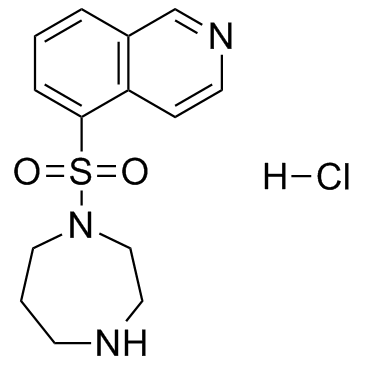
Fasudil (HA-1077) hydrochloride
CAS No. 105628-07-7
Fasudil (HA-1077) hydrochloride( HA-1077 | AT-877 )
Catalog No. M10257 CAS No. 105628-07-7
Fasudil hydrochloride(HA-1077; AT-877) is a potent inhibitor of ROCK-II, PKA, PKG, PKC, and MLCK.
Purity : >98% (HPLC)
 COA
Datasheet
HNMR
HPLC
MSDS
Handing Instructions
COA
Datasheet
HNMR
HPLC
MSDS
Handing Instructions
| Size | Price / USD | Stock | Quantity |
| 50MG | 32 | In Stock |


|
| 100MG | 41 | In Stock |
|
| 200MG | 61 | In Stock |
|
| 500MG | 87 | In Stock |
|
| 1G | Get Quote | In Stock |
|
Biological Information
-
Product NameFasudil (HA-1077) hydrochloride
-
NoteResearch use only, not for human use.
-
Brief DescriptionFasudil hydrochloride(HA-1077; AT-877) is a potent inhibitor of ROCK-II, PKA, PKG, PKC, and MLCK.
-
DescriptionFasudil hydrochloride(HA-1077; AT-877) is a potent inhibitor of ROCK-II, PKA, PKG, PKC, and MLCK with Ki of 0.33 μM, 1.6 μM, 1.6 μM, 3.3 μM and 36 μM, respectively.(In Vitro):Fasudil Hydrochloride (100 μM) inhibits cell spreading, the formation of stress fibers, and expression of α-SMA with concomitant suppression of cell growth in rat HSCs (hepatic stellate cells) and human HSC-derived TWNT-4 cells.Fasudil Hydrochloride (50-100 μM; 24 hours) inhibits the LPA (lysophoaphatidic acid)-induced phosphorylation of ERK1/2, JNK, and p38 detected by western blotting in rat HSCs and human HSC-derived TWNT-4 cells.Fasudil Hydrochloride (25-100 μM; 24 hours) suppresses transcription of collagen and TIMP, stimulates transcription of MMP-1 in human HSC-derived TWNT-4 cells. (In Vivo):Fasudil Hydrochloride (10 mg/kg; i.v.; 1 h before operation) exhibits protectable effects on cardiovascular disease and reduces the activation of JNK and attenuates mitochondrial-nuclear translocation of AIF under ischemic injury.Fasudil Hydrochloride (50 mg/kg/d; i.p.) inhibits acute and relapsing EAE (experimental autoimmune encephalomyelitis) induced by proteolipid protein PLP p139-151, reduces lymphocytes proliferation, results downregulation of interleukin (IL)-17 and a marked decrease of the IFN-γ/IL-4 ratio.Fasudil Hydrochloride (100 mg/kg/d; p.o.) significantly reduces incidence and pathological examination score of EAE (experimental autoimmune encephalomyelitis) in SJL/J mice, decreases inflammation, demyelination, axonal loss and APP positivein spinal cord in mice.
-
In VitroFasudil Hydrochloride (100 μM) inhibits cell spreading, the formation of stress fibers, and expression of α-SMA with concomitant suppression of cell growth in rat HSCs (hepatic stellate cells) and human HSC-derived TWNT-4 cells.Fasudil Hydrochloride (50-100 μM; 24 hours) inhibits the LPA (lysophoaphatidic acid)-induced phosphorylation of ERK1/2, JNK, and p38 detected by western blotting in rat HSCs and human HSC-derived TWNT-4 cells.Fasudil Hydrochloride (25-100 μM; 24 hours) suppresses transcription of collagen and TIMP, stimulates transcription of MMP-1 in human HSC-derived TWNT-4 cells. Western Blot Analysis Cell Line:Rat HSCs and human HSC-derived TWNT-4 cells Concentration:50 μM; 100 μM Incubation Time:24 hours Result:Suppressed the LPA-induced phosphorylation of ERK1/2, JNK and p38 MAPK by 60%, 70%,and 90%, respectively.RT-PCR Cell Line:Rat HSCs and human HSC-derived TWNT-4 cells Concentration:25 μM; 50 μM; 100 μM 24 hours Incubation Time:24 hours Result:Reduced the expression of type I collagen, a-SMA, and TIMP-1.
-
In VivoFasudil Hydrochloride (10 mg/kg; i.v.; 1 h before operation) exhibits protectable effects on cardiovascular disease and reduces the activation of JNK and attenuates mitochondrial-nuclear translocation of AIF under ischemic injury.?Fasudil Hydrochloride (50 mg/kg/d; i.p.) inhibits acute and relapsing EAE (experimental autoimmune encephalomyelitis) induced by proteolipid protein PLP p139-151, reduces lymphocytes proliferation, results downregulation of interleukin (IL)-17 and a marked decrease of the IFN-γ/IL-4 ratio.Fasudil Hydrochloride (100 mg/kg/d; p.o.) significantly reduces incidence and pathological examination score of EAE (experimental autoimmune encephalomyelitis) in SJL/J mice, decreases inflammation, demyelination, axonal loss and APP positivein spinal cord in mice. Animal Model:Myocardial ischemia and reperfusion in rat (250-300 g)Dosage:10 mg/kg Administration:Intravenous injection; 1 h before operation Result:Activated the Rho-kinase, JNK, and resulted AIF translocated to the nucleus.Inhibited Rho-kinase activity, and reduced myocardial infarct size and heart cell apoptosis.
-
SynonymsHA-1077 | AT-877
-
PathwayApoptosis
-
TargetPKA
-
RecptorPKA| PKG| PKC| ROCK2| MLCK
-
Research AreaCancer
-
Indication——
Chemical Information
-
CAS Number105628-07-7
-
Formula Weight327.83
-
Molecular FormulaC14H18ClN3O2S
-
Purity>98% (HPLC)
-
SolubilityWater: 65 mg/mL (198.27 mM); DMSO: 5 mg/mL (15.25 mM)
-
SMILESCl.Cl.O=S(=O)(N1CCCNCC1)C1=CC=CC2=C1C=CN=C2
-
Chemical Name——
Shipping & Storage Information
-
Storage(-20℃)
-
ShippingWith Ice Pack
-
Stability≥ 2 years
Reference
1.Ono-Saito N, et al. Pharmacol Ther, 1999, 82(2-3), 123-13
molnova catalog



related products
-
LX-7101 hydrochlorid...
LX-7101 hydrochloride is a potent LIMK and ROCK2 inhibitor with antihypertensive activity, inhibits LIMK1/2, ROCK, PKA, and can be used to study glaucoma.
-
GSK-J4 Hydrochloride
GSK-J4 is a cell permeable, potent and selective histone demethylase(JMJD3 )inhibitor. is an ethyl ester derivative of the GSK-J1 with an IC50 value greater than 50 μM in vitro.
-
Calcineurin substrat...
Calcineurin Substrate is a Peptide from the regulatory RII subunit of cAMP-dependent protein kinase.
