


 Cart
Cart
 sales@molnova.com


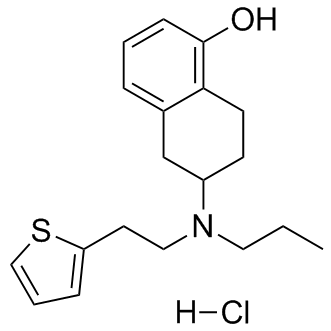
rac-Rotigotine hydrochloride
CAS No. 102120-99-0
rac-Rotigotine hydrochloride( —— )
Catalog No. M10100 CAS No. 102120-99-0
A non-selective agonist of the dopamine D3 receptor (Ki=0.71 nM); has 10-fold selectivity for the D3 receptor over the D2, D4, and D5 receptors and 100-fold selectivity for the D3 receptor over the D1 receptor.
Purity : >98% (HPLC)
 COA
Datasheet
HNMR
HPLC
MSDS
Handing Instructions
COA
Datasheet
HNMR
HPLC
MSDS
Handing Instructions
| Size | Price / USD | Stock | Quantity |
| 50MG | 141 | Get Quote |


|
| 100MG | Get Quote | Get Quote |
|
| 200MG | Get Quote | Get Quote |
|
| 500MG | Get Quote | Get Quote |
|
| 1G | Get Quote | Get Quote |
|
Biological Information
-
Product Namerac-Rotigotine hydrochloride
-
NoteResearch use only, not for human use.
-
Brief DescriptionA non-selective agonist of the dopamine D3 receptor (Ki=0.71 nM); has 10-fold selectivity for the D3 receptor over the D2, D4, and D5 receptors and 100-fold selectivity for the D3 receptor over the D1 receptor.
-
DescriptionA non-selective agonist of the dopamine D3 receptor (Ki=0.71 nM); has 10-fold selectivity for the D3 receptor over the D2, D4, and D5 receptors and 100-fold selectivity for the D3 receptor over the D1 receptor; behaves as a full agonist of D1, D2, and D3 with similar potencies (EC50) in functional assay; also demonstrates significant affinity at α-adrenergic (α2B, Ki=27 nM) and serotonin receptors (5-HT1A Ki=30 nM); significantly attenuates MPTP-induced acute cell degeneration in mouse model.Parkinson's Disease Approved.
-
In VitroRotigotine has a 10-fold selectivity for D3 (pKi=9.2) receptors compared with D2, D4 and D5 (pKi=8.5-8.0) and a 100-fold selectivity compared with D1 receptors (pKi=7.2). In functional studies, Rotigotine behaves as full agonist at all dopamine receptors but notably the potency for stimulation of D1 receptors is similar to that for D2 and D3 receptors (pEC50?respectively: 9.0, 9.4-8.6, 9.7).Rotigotine (10 μM) decreases the number of THir neurons by 40% in primary mesencephalic cell culture. Rotigotine (0.01 μM) slightly protects dopaminergic neurons against MPP+?toxicity, significantly protects dopaminergic neurons against rotenone-induced cell death, and significantly inhibits ROS production by rotenone.
-
In Vivo——
-
Synonyms——
-
PathwayGPCR/G Protein
-
TargetDopamine Receptor
-
RecptorDopamine Receptor
-
Research AreaNeurological Disease
-
IndicationParkinson Disease
Chemical Information
-
CAS Number102120-99-0
-
Formula Weight351.9338
-
Molecular FormulaC19H26ClNOS
-
Purity>98% (HPLC)
-
Solubility10 mM in DMSO
-
SMILESOC1=C2CCC(N(CCC)CCC3=CC=CS3)CC2=CC=C1.[H]Cl
-
Chemical Name1-Naphthalenol, 5,6,7,8-tetrahydro-6-[propyl[2-(2-thienyl)ethyl]amino]-, hydrochloride (1:1)
Shipping & Storage Information
-
Storage(-20℃)
-
ShippingWith Ice Pack
-
Stability≥ 2 years
Reference
1. Wood M, et al. Br J Pharmacol. 2015 Feb;172(4):1124-35.
2. Scheller D, et al. Naunyn Schmiedebergs Arch Pharmacol. 2009 Jan;379(1):73-86.
3. Scheller D, et al. Neurosci Lett. 2008 Feb 13;432(1):30-4.
molnova catalog



related products
-
ABT 724 trihydrochlo...
ABT 724 trihydrochloride is an effective and selective agonist of the D4 receptor (EC50 = 12.4 nM, 14.3 nM, and 23.2 nM for human, rat and ferret, respectively). ABT-724 trihydrochloride can be used in erectile dysfunction studies.
-
Bromopride
Bromopride is a dopamine antagonist with prokinetic properties closely related to metoclopramide, and is widely used as an antiemetic.
-
PNU-177864 hydrochlo...
PNU-177864 hydrochloride is a selective antagonist of D3 receptor with antischizophrenic activity.
