


 Cart
Cart
 sales@molnova.com


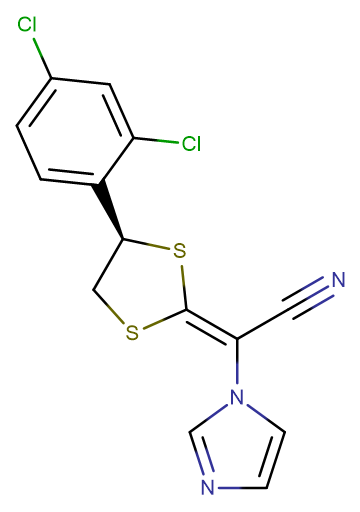
Luliconazole
CAS No. 187164-19-8
Luliconazole( NND-502 )
Catalog No. M12896 CAS No. 187164-19-8
Luliconazole is a broad-spectrum antifungal drug.
Purity : >98% (HPLC)
 COA
Datasheet
HNMR
HPLC
MSDS
Handing Instructions
COA
Datasheet
HNMR
HPLC
MSDS
Handing Instructions
| Size | Price / USD | Stock | Quantity |
| 25MG | 32 | In Stock |


|
| 50MG | 47 | In Stock |
|
| 100MG | 73 | In Stock |
|
| 200MG | 97 | In Stock |
|
| 500MG | Get Quote | In Stock |
|
| 1G | Get Quote | In Stock |
|
Biological Information
-
Product NameLuliconazole
-
NoteResearch use only, not for human use.
-
Brief DescriptionLuliconazole is a broad-spectrum antifungal drug.
-
DescriptionLuliconazole is a broad-spectrum antifungal drug.(In Vitro):The MICs of LLCZ against the organism measured by a standardized microdilution method using RPMI 1640 medium, were 0.002 μg/ml for T. mentagrophytes TIMM1189 and 0.002 μg/ml for TIMM2789.The minimum inhibitory concentrations (MIC) of luliconazole against Trichophyton spp. (T. rubrum, T. mentagrophytes and T. tonsurans) and Candida albicans are measured by the standardized broth microdilution method.Luliconazole demonstrates great potency against Trichophyton spp. (MIC range: 0.00012-0.002 μg/ml) than the reference agents, with T. rubrum being the most susceptible to it (MIC range: 0.00012-0.00024 μg/ml). Luliconazole is against T. mentagrophytes with MIC values ranging 0.00012-0.002 μg/ml. Luliconazole is also highly active against Candida albicans (MIC range: 0.031-0.13 μg/ml). Further, the MIC of luliconazole against Malassezia restricta is very low (MIC range: 0.004-0.016 μg/ml). (In Vivo):uliconazole (subcutaneous injection; 1, 5 and 25 mg/kg/day) is administered from the beginning of organogenesis (gestation day 7) through the end of lactation (lactation day 20). Luliconazole at 25 mg/kg presents maternal toxicity and embryofetal toxicity (increased prenatal pup mortality, reduced live litter sizes and increased postnatal pup mortality). Luliconazole at 5 mg/kg exhibits no embryofetal toxicity. Additionally, at 25 mg/kg/day has no treatment effects on postnatal development in rats.Luliconazole (appliance on skin; 0.02%-1%; 7-14 days) has dose-dependent therapeutic efficacy on skin, it exerts efficacy its even at a concentration of 0.02%, and its efficacy at 0.1% is equal to that of 1% bifonazole creama tinea corporis model (4- and 8-day treatment) and the tinea pedis model (7- and 14-day treatment).
-
In VitroThe MICs of LLCZ against the organism measured by a standardized microdilution method using RPMI 1640 medium, were 0.002 μg/ml for?T. mentagrophytes?TIMM1189 and 0.002 μg/ml for TIMM2789.The minimum inhibitory concentrations (MIC) of luliconazole against Trichophyton spp. (T. rubrum, T. mentagrophytes and T. tonsurans) and Candida albicans are measured by the standardized broth microdilution method.Luliconazole demonstrates great potency against Trichophyton spp. (MIC range: 0.00012-0.002 μg/ml) than the reference agents, with T. rubrum being the most susceptible to it (MIC range: 0.00012-0.00024 μg/ml). Luliconazole is against T. mentagrophytes with MIC values ranging 0.00012-0.002 μg/ml. Luliconazole is also highly active against Candida albicans (MIC range: 0.031-0.13 μg/ml). Further, the MIC of luliconazole against Malassezia restricta is very low (MIC range: 0.004-0.016 μg/ml).
-
In VivoLuliconazole (subcutaneous injection; 1, 5 and 25 mg/kg/day) is administered from the beginning of organogenesis (gestation day 7) through the end of lactation (lactation day 20). Luliconazole at 25 mg/kg presents maternal toxicity and embryofetal toxicity (increased prenatal pup mortality, reduced live litter sizes and increased postnatal pup mortality). Luliconazole at 5 mg/kg exhibits no embryofetal toxicity. Additionally, at 25 mg/kg/day has no treatment effects on postnatal development in rats.Luliconazole (appliance on skin; 0.02%-1%; 7-14 days) has dose-dependent therapeutic efficacy on skin, it exerts efficacy its even at a concentration of 0.02%, and its efficacy at 0.1% is equal to that of 1% bifonazole creama tinea corporis model?(4- and 8-day treatment) and the tinea pedis model (7- and 14-day treatment). Animal Model:Male specific-pathogen-free (SPF) Hartley guinea pig models of tinea corporis and tinea pedisDosage:0.02%-1% Administration:Appliance on skin; 0.02%-1%; 7-14 days Result:Was sufficiently potent for short-term treatment for dermatophytosis in vivo.
-
SynonymsNND-502
-
PathwayMicrobiology/Virology
-
TargetAntifungal
-
RecptorAntifungle
-
Research AreaInfection
-
Indication——
Chemical Information
-
CAS Number187164-19-8
-
Formula Weight354.28
-
Molecular FormulaC14H9Cl2N3S2
-
Purity>98% (HPLC)
-
SolubilityEthanol: 5 mg/mL (14.11 mM); DMSO: 71 mg/mL (200.4 mM)
-
SMILESN#C/C(N1C=CN=C1)=C2SC[C@@H](C3=CC=C(Cl)C=C3Cl)S/2
-
Chemical Name(2E)-[(4R)-4-(2,4-Dichlorophenyl)-1,3-dithiolan-2-ylidene](1H-imidazol-1-yl)acetonitrile
Shipping & Storage Information
-
Storage(-20℃)
-
ShippingWith Ice Pack
-
Stability≥ 2 years
Reference
1.Uchida K, et al. J Infect ChemOthers, 2004, 10(4), 216-219.
molnova catalog



related products
-
Wighteone
Wighteone (Erythrinin B) is a small molecule compound derived from Genista ephedroides with potential antifungal and anticancer activity against EGFR L858R/T790M mutant non-small cell lung cancer.
-
Fluxapyroxad
Fluxapyroxad is a broad-spectrum fungicide that inhibits the succinate dehydrogenase (SQR) enzyme.
-
Antibacterial agent ...
Antibacterial agent 132 showed antimicrobial activity against C. parapsilosis (ATCC 22019) and C. krusei (ATCC 6258) with MIC90 values of <0.06 μg/mL and 62.50 μg/mL, respectively.
