


 Cart
Cart
 sales@molnova.com


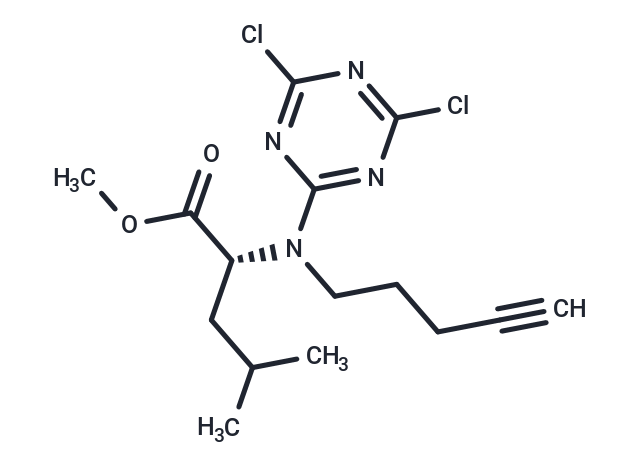
LAS17
CAS No. 2362527-67-9
LAS17( —— )
Catalog No. M35167 CAS No. 2362527-67-9
LAS17 is a selective and highly effective inhibitor of glutathione S-transferase Pi (GSTP1), which inhibits GSTP1 activity in vitro in a concentration-dependent manner.
Purity : >98% (HPLC)
 COA
Datasheet
HNMR
HPLC
MSDS
Handing Instructions
COA
Datasheet
HNMR
HPLC
MSDS
Handing Instructions
| Size | Price / USD | Stock | Quantity |
| 500MG | Get Quote | Get Quote |


|
| 1G | Get Quote | Get Quote |
|
Biological Information
-
Product NameLAS17
-
NoteResearch use only, not for human use.
-
Brief DescriptionLAS17 is a selective and highly effective inhibitor of glutathione S-transferase Pi (GSTP1), which inhibits GSTP1 activity in vitro in a concentration-dependent manner.
-
DescriptionLAS17 is a potent and selective tyrosine-directed irreversible inhibitor for glutathione S-Transferase Pi (GSTP1) . LAS17 inhibits GSTP1 activity with an IC50 of 0.5 μM. LAS17 is a click chemistry reagent, it contains an Alkyne group and can undergo copper-catalyzed azide-alkyne cycloaddition (CuAAc) with molecules containing Azide groups.
-
In VitroGlutathione?S-Transferase Pi (GSTP1) mediates cellular defense against reactive electrophiles. LAS17 inhibits GSTP1 activity?in vitro?in a concentration-dependent manner.?LAS17 (10 μM; Serum-free survival 48 h) treatment in 231MFP breast cancer cells recapitulates the serum-free cell survival impairments observed with genetic inactivation of GSTP1.? GSTP1 knockdown in LAS17 (10 μM) treatment in 231MFP cells results in increased levels of phosphorylated AMPK and acetyl CoA carboxylase (ACC).LAS17 treatment in 231MFP cells also shows reduced levels of ATP, lactic acid, purine nucleotides, and diacylated phospholipids and alkylacyl ether lipids and increased levels of acyl carnitines (ACs), ceramides, lysophospholipids Cell Viability Assay Cell Line:231MFP breast cancer cells Concentration:10 μM Incubation Time:48 hours Result:Recapitulated the serum-free cell survival impairments observed with genetic inactivation of GSTP1.Western Blot Analysis Cell Line:231MFP cells Concentration:10 μM Incubation Time:Result:LAS17-treated?231MFP cells show increased levels of phosphorylated AMPK and ACC.
-
In VivoDaily administration of LAS17 (20 mg/kg ip, once per day) significantly impairs 231MFP breast tumor xenograft growth in immune-deficient mice when treatment is initiated 2 days after subcutaneous injection of cells, and LAS17 even slows tumor growth when initiated 16 days after tumor implantation, with no observable toxicity and no weight-change.Animal Model:Severe combined immunodeficiency (SCID) mice bearing 231MFP tumor xenograft Dosage:20 mg/kg (prepared in PBS:ethanol:PEG40 (18:1:1)) Administration:Daily administration i.p., once per day Result:Significantly impaired 231MFP breast tumor xenograft growth.
-
Synonyms——
-
PathwayOthers
-
TargetOther Targets
-
RecptorGlutathione Peroxidase
-
Research Area——
-
Indication——
Chemical Information
-
CAS Number2362527-67-9
-
Formula Weight359.25
-
Molecular FormulaC15H20Cl2N4O2
-
Purity>98% (HPLC)
-
SolubilityIn Vitro:?DMSO : 100 mg/mL (278.36 mM; Ultrasonic )
-
SMILESN([C@@H](C(OC)=O)CC(C)C)(CCCC#C)C=1N=C(Cl)N=C(Cl)N1
-
Chemical Name——
Shipping & Storage Information
-
Storage(-20℃)
-
ShippingWith Ice Pack
-
Stability≥ 2 years
Reference
1. L A Crawford, et al. A tyrosine-reactive irreversible inhibitor for glutathione S-transferase Pi (GSTP1). Mol Biosyst.?2016 May 24;12(6):1768-71.?
molnova catalog



related products
-
Alpha-Obscurine
Alpha-Obscurine is a natural product of Lycopodium, Lycopodiaceae. Alpha-Obscurine can be used as a reference standard.
-
RXFP3/4 agonist 2
RXFP3/4 agonist 2 is a potent, non-peptidic bis-RXFP3/4 agonist that facilitates the interaction between RXFP3 and β-arrestin-2 and is useful for studying diseases caused by metabolic abnormalities.
-
Z-Gly-Gly-Arg-AMC
Z-Gly-Gly-Arg-AMC is a thrombin-specific fluorogenic substrate for testing of thrombin generation in PRP and platelet-poor plasma (PPP).
