


 Cart
Cart
 sales@molnova.com


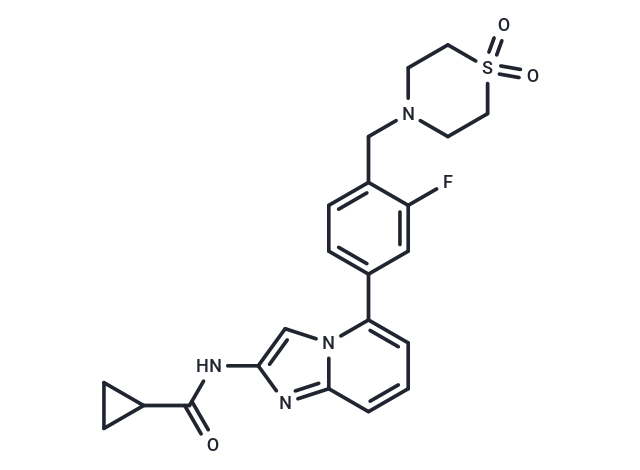
JAK1-IN-8
CAS No. 1973485-18-5
JAK1-IN-8( —— )
Catalog No. M34801 CAS No. 1973485-18-5
JAK1-IN-8, a specific inhibitor of Janus kinase 1 (JAK1, IC50<500 nM).
Purity : >98% (HPLC)
 COA
Datasheet
HNMR
HPLC
MSDS
Handing Instructions
COA
Datasheet
HNMR
HPLC
MSDS
Handing Instructions
| Size | Price / USD | Stock | Quantity |
| 5MG | 37 | Get Quote |


|
| 10MG | 68 | Get Quote |
|
| 25MG | 135 | Get Quote |
|
| 50MG | 242 | Get Quote |
|
| 100MG | 402 | Get Quote |
|
| 200MG | 538 | Get Quote |
|
| 500MG | Get Quote | Get Quote |
|
| 1G | Get Quote | Get Quote |
|
Biological Information
-
Product NameJAK1-IN-8
-
NoteResearch use only, not for human use.
-
Brief DescriptionJAK1-IN-8, a specific inhibitor of Janus kinase 1 (JAK1, IC50<500 nM).
-
DescriptionJAK1-IN-8, a potent JAK1 inhibitor (IC50<500 nM), compound 28, extracted from patent WO2016119700A1.
-
In Vitro——
-
In Vivo——
-
Synonyms——
-
PathwayAngiogenesis
-
TargetJAK
-
RecptorJAK
-
Research Area——
-
Indication——
Chemical Information
-
CAS Number1973485-18-5
-
Formula Weight442.51
-
Molecular FormulaC22H23FN4O3S
-
Purity>98% (HPLC)
-
SolubilityIn Vitro:?DMSO : 125 mg/mL (282.48 mM; Ultrasonic )
-
SMILESFc1cc(ccc1CN1CCS(=O)(=O)CC1)-c1cccc2nc(NC(=O)C3CC3)cn12
-
Chemical Name——
Shipping & Storage Information
-
Storage(-20℃)
-
ShippingWith Ice Pack
-
Stability≥ 2 years
Reference
1. Jin Li, et al. Composés d'imidazo[1,2-a]pyridin-2-ylamine substitués, compositions pharmaceutiques et leurs méthodes d'utilisation. Patent WO2016119700A1.
molnova catalog



related products
-
Tofacitinib
Tofacitinib (CP-690550) is a potent, specific, orally active inhibitor of JAK3 with IC50 of 1 nM in cell-free assays; displays 20- to 100-fold less potency for JAK2 and JAK1 (IC50=20 nM and 112 nM, respectively).
-
JAK-IN-5 hydrochlori...
JAK-IN-5 hydrochloride is an inhibitor of JAK.
-
BMS-986165
BMS-986165 is differentiated from previous JAK inhibitors due its unique ability to selectively bind to the pseudokinase (JH2) domain of TYK2 and inhibit its function through an allosteric mechanism.
