


 Cart
Cart
 sales@molnova.com


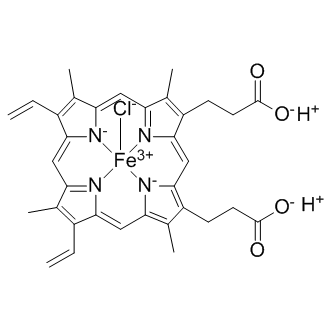
Hemin
CAS No. 16009-13-5
Hemin( Hemin chloride )
Catalog No. M12298 CAS No. 16009-13-5
Hemin, a physiological erythroid maturation stimulator, is able to induce the expression of critical autophagic genes (Map1a1b (LC3), Beclin-1 gen, Atg5) in an erythroleukemia cell type.
Purity : >98% (HPLC)
 COA
Datasheet
HNMR
HPLC
MSDS
Handing Instructions
COA
Datasheet
HNMR
HPLC
MSDS
Handing Instructions
| Size | Price / USD | Stock | Quantity |
| 1G | 38 | In Stock |


|
Biological Information
-
Product NameHemin
-
NoteResearch use only, not for human use.
-
Brief DescriptionHemin, a physiological erythroid maturation stimulator, is able to induce the expression of critical autophagic genes (Map1a1b (LC3), Beclin-1 gen, Atg5) in an erythroleukemia cell type.
-
DescriptionHemin, a physiological erythroid maturation stimulator, is able to induce the expression of critical autophagic genes (Map1a1b (LC3), Beclin-1 gen, Atg5) in an erythroleukemia cell type; increases the size of autophagic vacuoles and induces mitophagy in K562 cells; a heme oxygenase (HO) 1 inducer.(In Vitro):Hemin and PGJ2, used as positive controls, strongly increase both expression and activity of HMOX after 4 and 12 h, respectively. Indeed, a significant effect is found of 30 μM Hemin on cell proliferation in all used cell lines after 48 h, which is dose-dependent. Hemin treatment decreases cell proliferation to 62±5 %, 51±3 %, and 38±8 % in PA-TU-8902, BxPC-3 and MiaPaCa-2 cancer cells, respectively, with p<0.0001 for all comparisons. Furthermore, enhancement of anti-proliferative effects of statins is observed by Hemin, documented as decreased cell proliferation after 48 h of co-treatment. (In Vivo):Following the i.p. administration of Hemin (100 μmol/kg), the HO-1 level in the renal cortex begins to increase gradually. The HO-1 level reaches its peak 24 h after Hemin preconditioning. HO-1 is expressed mainly in the renal tubules. The HO-2 level in the kidney does not change following Hemin preconditioning.
-
In VitroHemin and PGJ2, used as positive controls, strongly increase both expression and activity of HMOX after 4 and 12 h, respectively. Indeed, a significant effect is found of 30 μM Hemin on cell proliferation in all used cell lines after 48 h, which is dose-dependent. Hemin treatment decreases cell proliferation to 62±5 %, 51±3 %, and 38±8 % in PA-TU-8902, BxPC-3 and MiaPaCa-2 cancer cells, respectively, with p<0.0001 for all comparisons. Furthermore, enhancement of anti-proliferative effects of statins is observed by Hemin, documented as decreased cell proliferation after 48 h of co-treatment.
-
In VivoFollowing the i.p. administration of Hemin (100 μmol/kg), the HO-1 level in the renal cortex begins to increase gradually. The HO-1 level reaches its peak 24 h after Hemin preconditioning. HO-1 is expressed mainly in the renal tubules. The HO-2 level in the kidney does not change following Hemin preconditioning.
-
SynonymsHemin chloride
-
PathwayAutophagy
-
TargetAutophagy
-
RecptorAutophagy
-
Research AreaCardiovascular Disease
-
Indication——
Chemical Information
-
CAS Number16009-13-5
-
Formula Weight651.9403
-
Molecular FormulaC34H32ClFeN4O4
-
Purity>98% (HPLC)
-
SolubilityDMSO: 6.6 mg/mL
-
SMILESCC1=C(CCC(O)=O)/C2=C/C3=C(CCC(O)=O)C(C)=C(/C=C4C(C)=C(C=C)C(/C=C5C(C)=C(C=C)C(/C=C1\[N-]2)=N/5)=N/4)[N-]3.[Fe+3]
-
Chemical NameFerrate(2-), chloro[7,12-diethenyl-3,8,13,17-tetramethyl-21H,23H-porphine-2,18-dipropanoato(4-)-κN21,κN22,κN23,κN24]-, hydrogen (1:2), (SP-5-13)-
Shipping & Storage Information
-
Storage(-20℃)
-
ShippingWith Ice Pack
-
Stability≥ 2 years
Reference
1. Fader CM, et al. Biol Cell. 2016 Apr;108(4):77-95.
2. Higdon AN, et al. Am J Physiol Heart Circ Physiol. 2012 Apr 1;302(7):H1394-409.
molnova catalog



related products
-
ARN-5187
A novel lysosomotropic REV-ERB ligand that has a dual inhibitory activity toward REV-ERB-mediated transcriptional regulation and autophagy.
-
O4I1
O4I1 is an effective Oct3/4 inducer.
-
Glaucocalyxin B
Glaucocalyxin B is a diterpenoid isolated from Rabdosia japonica with anticancer and antitumor activity. It decreases the growth of HL-60 cells (IC50: 5.86 μM).
