


 Cart
Cart
 sales@molnova.com


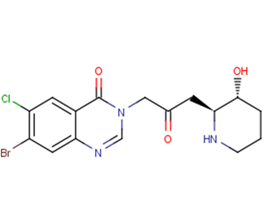
Halofuginone
CAS No. 55837-20-2
Halofuginone( RU 19110 | RU19110 | Halofuginone | Tempostatin )
Catalog No. M17543 CAS No. 55837-20-2
Halofuginone, the competitive inhibitor of prolyl-tRNA synthetase(Ki=18.3 nM), could also down-regulate Smad3 and blocked TGF-β signaling at 10 ng/ml in the mammal.
Purity : >98% (HPLC)
 COA
Datasheet
HNMR
HPLC
MSDS
Handing Instructions
COA
Datasheet
HNMR
HPLC
MSDS
Handing Instructions
| Size | Price / USD | Stock | Quantity |
| 5MG | 71 | In Stock |


|
| 10MG | 113 | In Stock |
|
| 25MG | 228 | In Stock |
|
| 50MG | 344 | In Stock |
|
| 100MG | 518 | In Stock |
|
| 500MG | 1134 | In Stock |
|
| 1G | Get Quote | In Stock |
|
Biological Information
-
Product NameHalofuginone
-
NoteResearch use only, not for human use.
-
Brief DescriptionHalofuginone, the competitive inhibitor of prolyl-tRNA synthetase(Ki=18.3 nM), could also down-regulate Smad3 and blocked TGF-β signaling at 10 ng/ml in the mammal.
-
DescriptionHalofuginone, also known as RU-19110, is a semisynthetic quinazolinone alkaloid anticoccidial derived from the plant Dichroa febrifuga, with antifibrotic and potential antineoplastic activities. Halofuginone specifically inhibits collagen type I gene expression and matrix metalloproteinase 2 (MMP-2) gene expression, which may result in the suppression of angiogenesis, tumor stromal cell development, and tumor cell growth. These effects appear to be due to halofuginone-mediated inhibition of the collagen type I and MMP-2 promoters.
-
In VitroHalofuginone competitively inhibits prolyl-tRNA synthetase by occupying both the prolineand tRNA-binding pockets of prolyl-tRNA synthetase. The IC50s of Halofuginone (1, 10, 100, 1000, 10000 nM; 48 hours) are 114.6 and 58.9 nM in KYSE70 and A549 cells, respectively. The IC50s of Halofuginone (1, 10, 100, 1000 nM; 24 hours) for NRF2 protein are 22.3 and 37.2 nM in KYSE70 and A549 cells, respectively. The IC50 of Halofuginone for global protein synthesis is 22.6 and 45.7 nM in KYSE70 and A549 cells, respectively. Halofuginone increases voltage-gated K+ (Kv) currents in pulmonary artery smooth muscle cells (PASMC) and K+ currents through KCNA5 channels in HEK cells transfected with KCNA5 gene. Halofuginone (0.03-1μM) inhibits receptor-operated Ca2+ entry (ROCE) in HEK cells transfected with calcium-sensing receptor gene and attenuates store-operated Ca2+ entry (SOCE) in PASMC.Cell Viability Assay Cell Line:KYSE70 cells from human oesophageal cancer harbouring a mutation in the NRF2 gene and A549 cells harbouring theKEAP1 gene mutation Concentration:1, 10, 100, 1000, 10000 nM Incubation Time:48 hours Result:The IC50s were 114.6 and 58.9 nM in KYSE70 and A549 cells, respectively.Western Blot Analysis Cell Line:KYSE70 cells from human oesophageal cancer harbouring a mutation in the NRF2 gene and A549 cells harbouring theKEAP1 gene mutation.Concentration:1, 10, 100, 1000 nM Incubation Time:24 hours Result:The IC50s for NRF2 protein were 22.3 and 37.2 nM in KYSE70 and A549 cells, respectively.
-
In VivoHalofuginone (0.2, 0.5, 1 or 2.5 mg/kg; injected intraperitoneally every other day for 1 month) attenuates progression of OA in anterior cruciate ligament transection (ACLT) mice. Lower concentration (0.2 or 0.5 mg/kg) has minimal effects on subchondral bone and higher concentration (2.5 mg/kg) induces proteoglycan loss in articular cartilage. Halofuginone (0.25 mg/kg; intraperitoneally injected; every day; 16 days) decreases NRF2 protein levels in tumors. While the tumor volumes do not change substantially between treatments with the vehicle, Halofuginone (0.25 mg/kg, intraperitoneally injected, every day) or cisplatin alone. Combined treatment with Halofuginone and Cisplatin significantly suppresses the tumor volume compared to treatment with Halofuginone or cisplatin alone.Intraperitoneal administration of Halofuginone (0.3mg/kg, for 2 weeks) partially reverses the established pulmonary hypertension in mice. Animal Model:3-month-old male C57BL/6J (WT) miceDosage:0.2, 0.5, 1 or 2.5 mg/kg Administration:Injected intraperitoneally every other day for 1 month Result:Attenuated progression of OA in ACLT mice.Animal Model:Male nude mice (BALB/C nu/nu mice) (6-8-week) Dosage:0.25 mg/kg Administration:Intraperitoneally injected; every day; 16 daysResult:The combined treatment with Cisplatin significantly suppressed the tumor volume. NRF2 protein levels in tumors were indeed decreased.
-
SynonymsRU 19110 | RU19110 | Halofuginone | Tempostatin
-
PathwayMetabolic Enzyme/Protease
-
TargetRetinoid Receptor
-
Recptorprolyl-tRNA synthetase
-
Research AreaInflammation/Immunology
-
Indication——
Chemical Information
-
CAS Number55837-20-2
-
Formula Weight414.68
-
Molecular FormulaC16H17BrClN3O3
-
Purity>98% (HPLC)
-
SolubilityDMSO : 9 mg/mL. 21.70 mM;
-
SMILESC1C[C@H]([C@@H](NC1)CC(=O)Cn1cnc2cc(c(cc2c1=O)Cl)Br)O
-
Chemical Name7-bromo-6-chloro-3-(3-((2S,3R)-3-hydroxypiperidin-2-yl)-2-oxopropyl)quinazolin-4(3H)-one.
Shipping & Storage Information
-
Storage(-20℃)
-
ShippingWith Ice Pack
-
Stability≥ 2 years
Reference
1.Runlong Lin, et al. Onco Targets Ther. 2015; 8: 3549–3559.
molnova catalog



related products
-
Isotretinoin
Isotretinoin(13-cis-Retinoic acid) is a medication used for the treatment of severe acne.
-
ER 50891
ER-50891 is a potent retinoic acid receptor alpha (RARα) antagonist. er-50891 reduces the inhibitory effect of allosteric retinoic acid and restores osteoblast differentiation induced by bone morphogenetic protein 2.
-
trifarotene
trifarotene is a potent and selective RARγ agonist with 65-fold and 16-fold selectivitiy for the RARγ (EC50=7.7 nM) over RARα (EC50=500 nM) and RARβ (EC50=125 nM).
