


 Cart
Cart
 sales@molnova.com


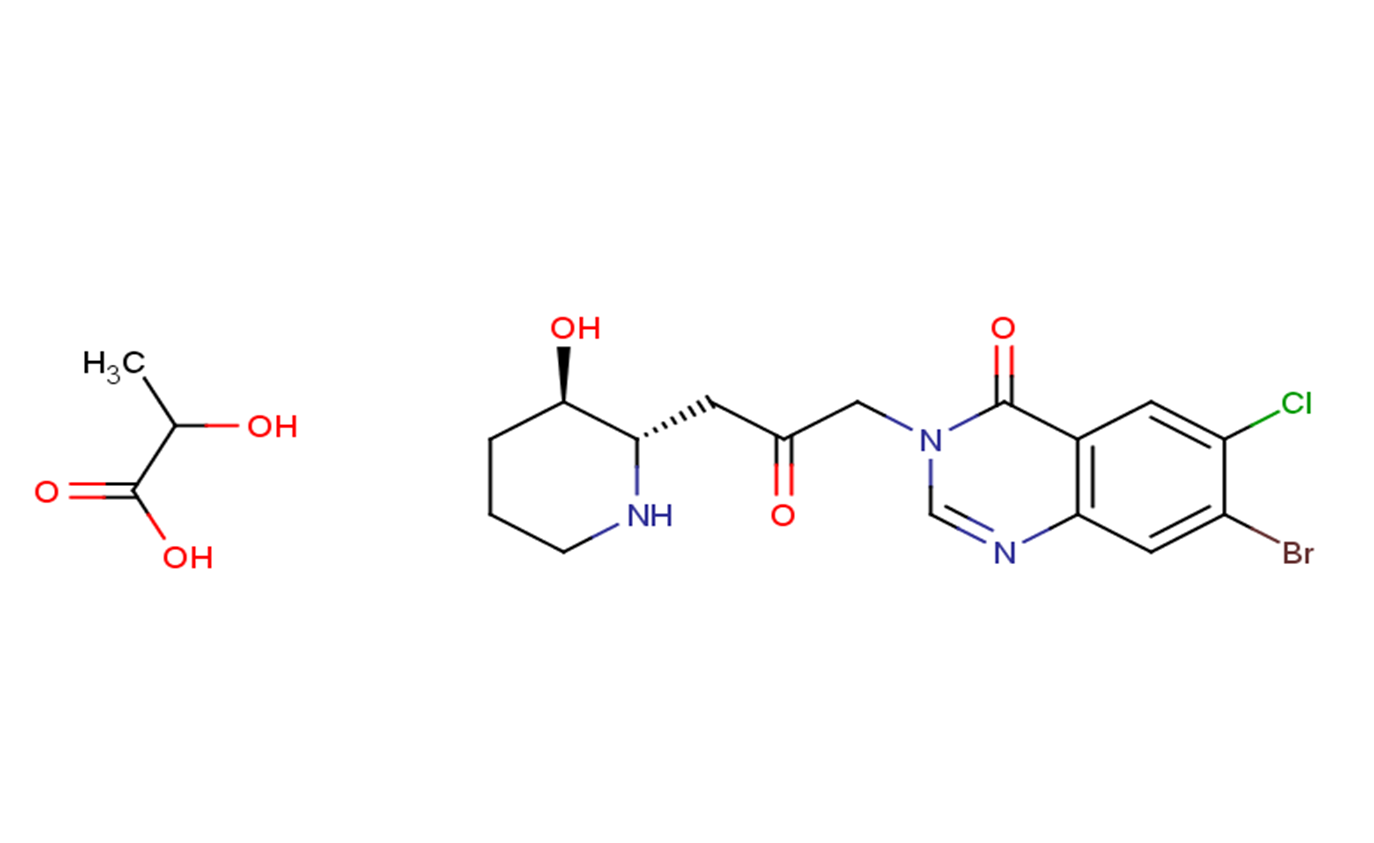
HALOFUGINONE LACTATE
CAS No. 82186-71-8
HALOFUGINONE LACTATE( —— )
Catalog No. M22897 CAS No. 82186-71-8
HALOFUGINONE LACTATE is a halogenated derivative of febrifugine, a natural quinazolinone-containing compound found in the Chinese herb D. febrifuga.Halofuginone inhibits prolyl-tRNA synthetase in an ATP-dependent manner with a Ki of 18.3 nM. Halofuginone is a specific inhibitor of type-I collagen synthesis and attenuates osteoarthritis (OA) by inhibition of TGF-β activityhalofuginone (HF), a widely studied derivative of febrifugine, inhibits the development of T(H)17-driven autoimmunity in a mouse model of multiple sclerosis by activating the amino acid response (AAR) pathway. HF binds glutamyl-prolyl-tRNA synthetase (EPRS), inhibiting prolyl-tRNA synthetase activity; this inhibition is reversed by the addition of exogenous proline or EPRS.
Purity : >98% (HPLC)
 COA
Datasheet
HNMR
HPLC
MSDS
Handing Instructions
COA
Datasheet
HNMR
HPLC
MSDS
Handing Instructions
| Size | Price / USD | Stock | Quantity |
| 1 mL x 10 mM in DMSO | 58 | In Stock |


|
| 2MG | 33 | In Stock |
|
| 5MG | 51 | In Stock |
|
| 10MG | 82 | In Stock |
|
| 25MG | 125 | In Stock |
|
| 50MG | 203 | In Stock |
|
| 100MG | 303 | In Stock |
|
| 200MG | 452 | In Stock |
|
| 500MG | Get Quote | In Stock |
|
| 1G | Get Quote | In Stock |
|
Biological Information
-
Product NameHALOFUGINONE LACTATE
-
NoteResearch use only, not for human use.
-
Brief DescriptionHALOFUGINONE LACTATE is a halogenated derivative of febrifugine, a natural quinazolinone-containing compound found in the Chinese herb D. febrifuga.Halofuginone inhibits prolyl-tRNA synthetase in an ATP-dependent manner with a Ki of 18.3 nM. Halofuginone is a specific inhibitor of type-I collagen synthesis and attenuates osteoarthritis (OA) by inhibition of TGF-β activityhalofuginone (HF), a widely studied derivative of febrifugine, inhibits the development of T(H)17-driven autoimmunity in a mouse model of multiple sclerosis by activating the amino acid response (AAR) pathway. HF binds glutamyl-prolyl-tRNA synthetase (EPRS), inhibiting prolyl-tRNA synthetase activity; this inhibition is reversed by the addition of exogenous proline or EPRS.
-
DescriptionHALOFUGINONE LACTATE is a halogenated derivative of febrifugine, a natural quinazolinone-containing compound found in the Chinese herb D. febrifuga.Halofuginone inhibits prolyl-tRNA synthetase in an ATP-dependent manner with a Ki of 18.3 nM. Halofuginone is a specific inhibitor of type-I collagen synthesis and attenuates osteoarthritis (OA) by inhibition of TGF-β activityhalofuginone (HF), a widely studied derivative of febrifugine, inhibits the development of T(H)17-driven autoimmunity in a mouse model of multiple sclerosis by activating the amino acid response (AAR) pathway. HF binds glutamyl-prolyl-tRNA synthetase (EPRS), inhibiting prolyl-tRNA synthetase activity; this inhibition is reversed by the addition of exogenous proline or EPRS.
-
In Vitro——
-
In Vivo——
-
Synonyms——
-
PathwayCell Cycle/DNA Damage
-
TargetDNA/RNA Synthesis
-
Recptorprolyl-tRNA synthetase|TGF-β
-
Research AreaOthers
-
IndicationDuchenne muscular dystrophy
Chemical Information
-
CAS Number82186-71-8
-
Formula Weight504.8
-
Molecular FormulaC19H23BrClN3O6
-
Purity>98% (HPLC)
-
Solubility——
-
SMILESCC(O)C(O)=O.O=C1N(CC(C[C@@H]2NCCC[C@H]2O)=O)C=NC3=C1C=C(Cl)C(Br)=C3
-
Chemical Name——
Shipping & Storage Information
-
Storage(-20℃)
-
ShippingWith Ice Pack
-
Stability≥ 2 years
Reference
1. Keller TL, et al. Halofuginone and other Febrifugine derivatives inhibit prolyl-tRNA synthetase. Nat Chem Biol. 2012 Feb 12;8(3):311-7.
molnova catalog



related products
-
Dmt-2fluoro-da(bz) a...
Dmt-2'fluoro-da(bz) amidite is a 2'-deoxy-2'-fluoro-phosphorothioate oligonucleotide with high affinity and specificity for RNA targets and serves as an intermediate in the synthesis of 5'-DMT-3'-phosphoramidite, an antisense compound resistant to nuclease.
-
Gemcitabine HCl
Gemcitabine HCl is a DNA synthesis inhibitor with IC50 of 50 nM, 40 nM, 18 nM and 12 nM in PANC1, MIAPaCa2, BxPC3 and Capan2 cells, respectively.
-
3-O-Acetyl-beta-bosw...
3-O-Acetyl-beta-boswellic acid has antitumor activity, it inhibits synthesis of DNA, RNA and protein in human leukemia HL-60 cells in a dose dependent manner with IC50 values ranging from 0.6 to 7.1 microM.
