


 Cart
Cart
 sales@molnova.com


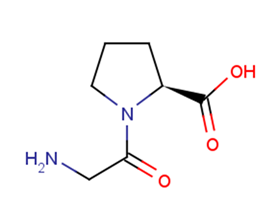
H-Gly-Pro-OH
CAS No. 704-15-4
H-Gly-Pro-OH( Glycyl proline | Glycyl-L-proline )
Catalog No. M20287 CAS No. 704-15-4
H-Gly-Pro-OH is a dipeptide composed of glycine and proline and is an end product of collagen metabolism.
Purity : >98% (HPLC)
 COA
Datasheet
HNMR
HPLC
MSDS
Handing Instructions
COA
Datasheet
HNMR
HPLC
MSDS
Handing Instructions
| Size | Price / USD | Stock | Quantity |
| 100MG | 38 | In Stock |


|
| 200MG | Get Quote | In Stock |
|
| 500MG | Get Quote | In Stock |
|
| 1G | Get Quote | In Stock |
|
Biological Information
-
Product NameH-Gly-Pro-OH
-
NoteResearch use only, not for human use.
-
Brief DescriptionH-Gly-Pro-OH is a dipeptide composed of glycine and proline and is an end product of collagen metabolism.
-
DescriptionH-Gly-Pro-OH is a dipeptide composed of glycine and proline and is an end product of collagen metabolism.
-
In Vitro——
-
In Vivo——
-
SynonymsGlycyl proline | Glycyl-L-proline
-
PathwayProteasome/Ubiquitin
-
TargetEndogenous Metabolite
-
RecptorHuman Endogenous Metabolite
-
Research Area——
-
Indication——
Chemical Information
-
CAS Number704-15-4
-
Formula Weight172.18
-
Molecular FormulaC7H12N2O3
-
Purity>98% (HPLC)
-
SolubilityWater:34 mg/mL (197.46 mM)
-
SMILESNCC(=O)N1CCC[C@H]1C(O)=O
-
Chemical Name——
Shipping & Storage Information
-
Storage(-20℃)
-
ShippingWith Ice Pack
-
Stability≥ 2 years
Reference
1.Le J Perier C Peyroche S et al. Urine glycyl-L-proline increase and skin trophicity[J]. Amino Acids (Vienna) 1999 17(3):315-322.
molnova catalog



related products
-
4-ACETAMIDOBUTYRIC A...
4-Acetamidobutanoic acid can be found in blood feces and urine as well as in human prostate tissue. 4-Acetamidobutanoic acid exists in all eukaryotes ranging from yeast to humans.
-
8-Hydroxy-2'-deoxygu...
8-Oxo-dG is a good biomarker for risk assessment of various cancers and degenerative diseases.
-
L-Lactic acid
Lactic acid is an organic acid. It is a chiral molecule consisting of two optical isomers L-lactic acid and D-lactic acid with the L-isomer being the most common in living organisms. Lactic acid plays a role in several biochemical processes and is produced in the muscles during intense activity.
