


 Cart
Cart
 sales@molnova.com


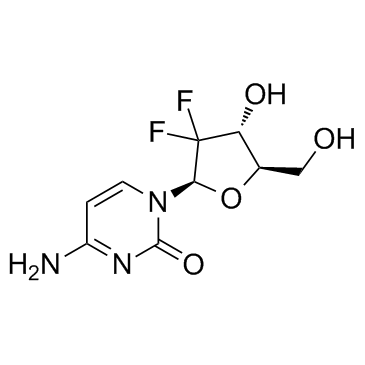
Gemcitabine
CAS No. 95058-81-4
Gemcitabine( LY 188011 | NSC 613327 | LY188011 | LY-188011 )
Catalog No. M16797 CAS No. 95058-81-4
A synthetic pyrimidine nucleoside prodrug that works by ihibiting the enzyme ribonucleotide reductase (RNR) and blocking the creation of new DNA.
Purity : >98% (HPLC)
 COA
Datasheet
HNMR
HPLC
MSDS
Handing Instructions
COA
Datasheet
HNMR
HPLC
MSDS
Handing Instructions
| Size | Price / USD | Stock | Quantity |
| 50MG | 31 | In Stock |


|
| 100MG | 45 | In Stock |
|
| 200MG | 52 | In Stock |
|
| 500MG | 77 | In Stock |
|
| 1G | 88 | In Stock |
|
Biological Information
-
Product NameGemcitabine
-
NoteResearch use only, not for human use.
-
Brief DescriptionA synthetic pyrimidine nucleoside prodrug that works by ihibiting the enzyme ribonucleotide reductase (RNR) and blocking the creation of new DNA.
-
DescriptionA synthetic pyrimidine nucleoside prodrug that works by ihibiting the enzyme ribonucleotide reductase (RNR) and blocking the creation of new DNA; a chemotherapy agent for treatment of a number of types of cancer.Chemotherapeutic Agents Approved(In Vitro):Gemcitabine (purchased from MedChem Express, 0.003-1 μM; 3 days) kills both mouse and human senescent cells effectively and potently.Gemcitabine inhibits the growth of BxPC-3, Mia Paca-2, PANC-1, PL-45 and AsPC-1 cells with IC50s of 37.6, 42.9, 92.7, 89.3 and 131.4 nM, respectively.(In Vivo):Gemcitabine can be administered via endotracheal spray in rats without marked toxicity with a maximum tolerated dose of 4 mg/kg once a week for 9 weeks. The toxicity of Gemcitabine is lower via lung than oral administration at dosages of 2, 4, and 6 mg/kg.Treatment of the LSL-KrasG12D/+; LSL-Trp53R172H; Pdx-1-Cre mice with either Gemcitabine (50 mg/kg, i.p.) or the combination DMAPT/Gemcitabine significantly increases the median survival time by more than 30 days compared to the placebo group (254.5 or 255 days vs. 217.5 days, respectively).
-
In VitroCell Viability Assay Cell Line:Non-senescent and replication-induced senescent new born dermal fibroblasts (NBFs) Concentration:0.003, 0.01, 0.03, 0.1, 0.3, 1 μM Incubation Time:3 days Result:Killed replication-induced senescent NBFs for 3 days with 11.0% cell viability.
-
In Vivo——
-
SynonymsLY 188011 | NSC 613327 | LY188011 | LY-188011
-
PathwayCell Cycle/DNA Damage
-
TargetNucleoside Antimetabolite/Analog
-
RecptorAutophagy|Thymidylatesynthase|UMP-CMPkinase
-
Research AreaCancer
-
IndicationChemotherapeutic
Chemical Information
-
CAS Number95058-81-4
-
Formula Weight263.1982
-
Molecular FormulaC9H11F2N3O4
-
Purity>98% (HPLC)
-
Solubility10 mM in DMSO
-
SMILESC1=CN(C(=O)N=C1N)[C@H]2C([C@@H]([C@H](O2)CO)O)(F)F
-
Chemical NameCytidine, 2'-deoxy-2',2'-difluoro-
Shipping & Storage Information
-
Storage(-20℃)
-
ShippingWith Ice Pack
-
Stability≥ 2 years
Reference
molnova catalog



related products
-
Tipiracil hydrochlor...
Tipiralacil, also known as TPI, is a thymidine phosphorylase inhibitor (TPI).
-
Acelarin
A gemcitabine phosphoramidate prodrug that can overcome the key cancer resistance.
-
Isoguanine
Isoguanine is a purine base that is an isomer of guanine. A building block in organic synthesis.
