


 Cart
Cart
 sales@molnova.com


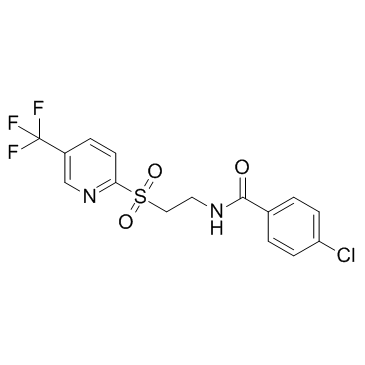
GSK3787
CAS No. 188591-46-0
GSK3787( GSK3787 | GSK-3787 | GSK 3787 )
Catalog No. M12948 CAS No. 188591-46-0
GSK3787 is as a selective and irreversible antagonist of PPARδ with pIC50 of 6.6, with no measurable affinity for hPPARα or hPPARγ.
Purity : >98% (HPLC)
 COA
Datasheet
HNMR
HPLC
MSDS
Handing Instructions
COA
Datasheet
HNMR
HPLC
MSDS
Handing Instructions
| Size | Price / USD | Stock | Quantity |
| 5MG | 45 | In Stock |


|
| 10MG | 71 | In Stock |
|
| 25MG | 165 | In Stock |
|
| 50MG | 293 | In Stock |
|
| 100MG | 493 | In Stock |
|
| 500MG | 1053 | In Stock |
|
| 1G | Get Quote | In Stock |
|
Biological Information
-
Product NameGSK3787
-
NoteResearch use only, not for human use.
-
Brief DescriptionGSK3787 is as a selective and irreversible antagonist of PPARδ with pIC50 of 6.6, with no measurable affinity for hPPARα or hPPARγ.
-
DescriptionGSK3787 is as a selective and irreversible antagonist of PPARδ with pIC50 of 6.6, with no measurable affinity for hPPARα or hPPARγ.
-
In VitroGSK3787 is identified as a potent and selective hPPARδ ligand (pIC50=6.6) with no measurable affinity for hPPARα or hPPARγ (pIC50 < 5) in our standard in vitro ligand displacement assay. GSK3787 is inactive against hPPARα and hPPARγ in similar functional antagonist assays. GSK3787 fails to activate the receptor in a standard hPPARδ-GAL4 chimera cell-based reporter assay. GSK3787 is a selective PPARδ antagonist with equipotent species activity against the human and mouse receptor.
-
In VivoGSK3787 has pharmacokinetic properties suitable for use as an in vivo PPARδ antagonist tool compound in mice. GSK3787 is administered intravenously (0.5 mg/kg) and orally (10 mg/kg) to male C57BL/6 mice. Mean clearance (CL) and volume of distribution at steady state (Vss) following iv administration are 39±11 (mL/min)/kg and 1.7±0.4 L/kg, respectively. Following oral administration, good exposure (Cmax=881±166 ng/mL, AUCinf=3343±332 h?ng/mL), half-life (2.7±1.1 h), and bioavailability (F=77±17%) are observed. Oral administration of GSK3787 (10 mg/kg) leads to a serum Cmax of 2.2±0.4 μM in C57BL/6 male mice. Oral administration of GW0742 causes an increase in expression of Angptl4 and Adrp mRNA (known PPARβ/δ target genes) in wild-type mouse colon epithelium, and this effect is not found in Pparβ/δ-null mouse colon epithelium. Coadministration of GSK3787 with GW0742 effectively prevents the ligand-induced expression of both Angptl4 and Adrp mRNA in wild-type mouse colon epithelium, and this effect is not found in Pparβ/δ-null mouse colon epithelium. Oral administration of GSK3787 causes a modest increase in promoter occupancy of PPARβ/δ in the PPRE region of both the Angptl4 and Adrp genes, but coadministration of GSK3787 with GW0742 results in markedly less accumulation of PPARβ/δ in the PPRE region of both the Angptl4 and Adrp genes in wild-type mouse colon epithelium.
-
SynonymsGSK3787 | GSK-3787 | GSK 3787
-
PathwayMetabolic Enzyme/Protease
-
TargetPPAR
-
RecptorPPARδ
-
Research AreaOther Indications
-
Indication——
Chemical Information
-
CAS Number188591-46-0
-
Formula Weight392.78
-
Molecular FormulaC15H12ClF3N2O3S
-
Purity>98% (HPLC)
-
SolubilityDMSO: 79 mg/mL (201.13 mM)
-
SMILESO=C(NCCS(=O)(C1=NC=C(C(F)(F)F)C=C1)=O)C2=CC=C(Cl)C=C2
-
Chemical Name4-chloro-N-(2-((5-(trifluoromethyl)pyridin-2-yl)sulfonyl)ethyl)benzamide
Shipping & Storage Information
-
Storage(-20℃)
-
ShippingWith Ice Pack
-
Stability≥ 2 years
Reference
1.Shearer BG, et al. J Med Chem, 2010, 53(4), 1857-186
molnova catalog



related products
-
Tesaglitazar
Tesaglitazar is a potent and selective peroxide PPARα / γ receptor dual agonist with a more potent affinity for PPARγ than PPARα, The EC50 values for rat PPARα and human PPARα were 13.4 μM and 3.6 μM, respectively, and 0.2 μM for rat PPARγ and human PPARγ.
-
Rosiglitazone
A potent and selective PPARγ agonist that binds to the PPARγ ligand-binding domain with a Kd of 40 nM.
-
Ciglitazone
Ciglitazone (ADD 3878) is a potent and selective PPARγ agonist (EC50: 3 μM) and oral hypoglycemic agent.
