


 Cart
Cart
 sales@molnova.com


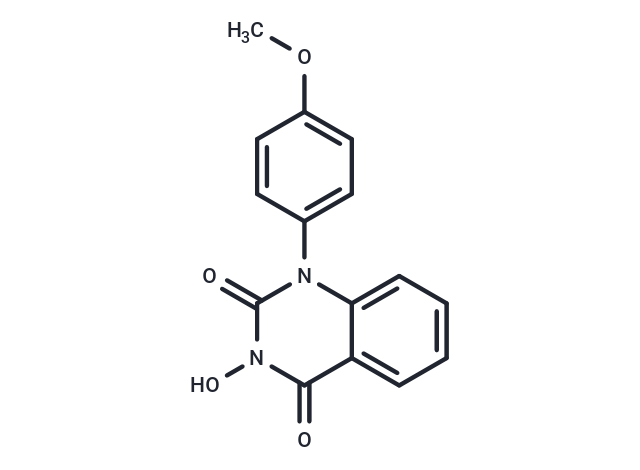
FEN1-IN-3
CAS No. 2109805-87-8
FEN1-IN-3( —— )
Catalog No. M37614 CAS No. 2109805-87-8
FEN1-IN-3 is a human flap endonuclease-1 ( hFEN1 ) inhibitor that stabilizes hFEN1 with an EC 50 of 6.8 μM .
Purity : >98% (HPLC)
 COA
Datasheet
HNMR
HPLC
MSDS
Handing Instructions
COA
Datasheet
HNMR
HPLC
MSDS
Handing Instructions
| Size | Price / USD | Stock | Quantity |
| 2MG | 50 | Get Quote |


|
| 5MG | 72 | Get Quote |
|
| 10MG | 122 | Get Quote |
|
| 25MG | 210 | Get Quote |
|
| 50MG | 342 | Get Quote |
|
| 100MG | 560 | Get Quote |
|
| 500MG | 1152 | Get Quote |
|
| 1G | Get Quote | Get Quote |
|
Biological Information
-
Product NameFEN1-IN-3
-
NoteResearch use only, not for human use.
-
Brief DescriptionFEN1-IN-3 is a human flap endonuclease-1 ( hFEN1 ) inhibitor that stabilizes hFEN1 with an EC 50 of 6.8 μM .
-
DescriptionFEN1-IN-3 (Compound 4) is a human flap endonuclease-1 (hFEN1) inhibitor. FEN1-IN-3 stabilizes hFEN1 with an EC50 of 6.8 μM.
-
In Vitro——
-
In Vivo——
-
Synonyms——
-
PathwayOthers
-
TargetOther Targets
-
RecptorOthers
-
Research Area——
-
Indication——
Chemical Information
-
CAS Number2109805-87-8
-
Formula Weight284.27
-
Molecular FormulaC15H12N2O4
-
Purity>98% (HPLC)
-
SolubilityIn Vitro:?DMSO : 250 mg/mL (879.45 mM; Ultrasonic )
-
SMILESCOc1ccc(cc1)-n1c2ccccc2c(=O)n(O)c1=O
-
Chemical Name——
Shipping & Storage Information
-
Storage(-20℃)
-
ShippingWith Ice Pack
-
Stability≥ 2 years
Reference



-
(R)-Ambrisentan-d3
(R)-Ambrisentan-d3 is the deuterated version of (R)-Ambrisentan (A575873), which is the R-isomer impurity of Ambrisentan (A575860) that is a nonpeptide endothelin ETA receptor antagonist.
-
Human IgG1 Control
Human IgG1 Control was purified from Human serum by chromatography.Human IgG1 Control can be used as a Control, standard, blocking agent, or coating protein in a variety of experiments, including ELISA, Western and blotting, immunoprecipitation, and immunoelectrophoresis.Human IgG1 Control can also be used as an antigen or ligand in immunochemical conjugate reactions.
-
Myristoyl-L-carnitin...
Myristoyl-L-carnitine chloride (L-Myristoylcarnitine chloride) is one of the body's metabolites implicated in inherited metabolic disorders.Tetradecanoylcarnitine is a potential marker for the study of diabetes mellitus and autoimmune hepatitis.
