


 Cart
Cart
 sales@molnova.com


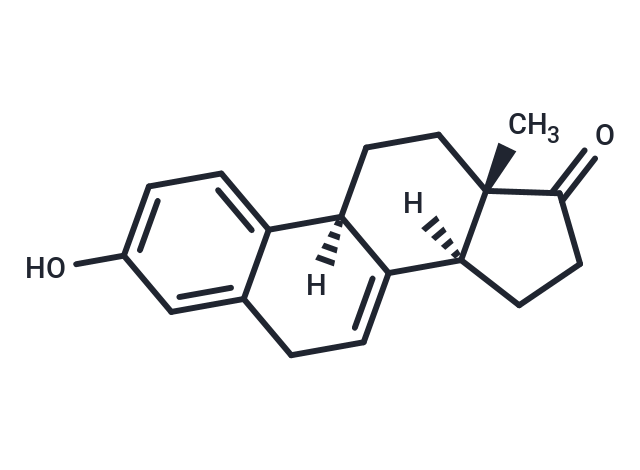
Equilin
CAS No. 474-86-2
Equilin( —— )
Catalog No. M33216 CAS No. 474-86-2
Equilin (7-Dehydroestrone) is a neurotrophic estrogenic steroid with vasodilatory activity that increases monocyte-endothelial adhesion through NF-κB signalling.
Purity : >98% (HPLC)
 COA
Datasheet
HNMR
HPLC
MSDS
Handing Instructions
COA
Datasheet
HNMR
HPLC
MSDS
Handing Instructions
| Size | Price / USD | Stock | Quantity |
| 2MG | 46 | Get Quote |


|
| 5MG | 59 | Get Quote |
|
| 10MG | 97 | Get Quote |
|
| 500MG | Get Quote | Get Quote |
|
| 1G | Get Quote | Get Quote |
|
Biological Information
-
Product NameEquilin
-
NoteResearch use only, not for human use.
-
Brief DescriptionEquilin (7-Dehydroestrone) is a neurotrophic estrogenic steroid with vasodilatory activity that increases monocyte-endothelial adhesion through NF-κB signalling.
-
DescriptionEquilin (7-Dehydroestrone) is an important member of the large group of oestrogenic substances and is chemically related to menformon (oestrone). Equilin increases the growth of cortical neurons via an NMDA receptor-dependent mechanism.
-
In Vitro——
-
In Vivo——
-
Synonyms——
-
PathwayGPCR/G Protein
-
TargetCalcium Channel
-
RecptorCalcium Channel
-
Research Area——
-
Indication——
Chemical Information
-
CAS Number474-86-2
-
Formula Weight268.35
-
Molecular FormulaC18H20O2
-
Purity>98% (HPLC)
-
SolubilityIn Vitro:?DMSO : 100 mg/mL (372.65 mM; Ultrasonic )
-
SMILES[H][C@@]12CCC(=O)[C@@]1(C)CC[C@@]1([H])C2=CCc2cc(O)ccc12
-
Chemical Name——
Shipping & Storage Information
-
Storage(-20℃)
-
ShippingWith Ice Pack
-
Stability≥ 2 years
Reference



-
Temiverine hydrochlo...
Temiverine hydrochloride is a potential calcium channel antagonist with anticholinergic effects that inhibits some of the functions of atropine.
-
Ziconotide Acetate ...
Ziconotide is an analgesic agent and has been used to treat neuropathic and non-neuropathic pain. Ziconotide acts by binding to N-type calcium channels situated on the terminal part of primary afferent neurons of the nociceptive pathway therefore reducing synaptic transmission with potent antinociceptive effects.
-
Ticolubant
Ticolubant is orally active leukotriene B4 antagonist with high affinity for the human neutrophil LTB4 receptor (Ki = 0.78 nM), blocks LTB4-induced Ca2+ migration with an IC50 of 6.6 ± 1.5 nM, and shows topical anti-inflammatory activity in a mouse model of skin inflammation.
