


 Cart
Cart
 sales@molnova.com


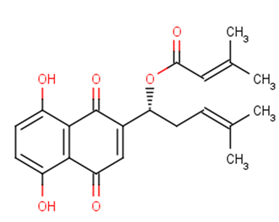
Dimethylacrylshikonin
CAS No. 24502-79-2
Dimethylacrylshikonin( —— )
Catalog No. M18302 CAS No. 24502-79-2
Dimethylacrylshikonin is a promising agent for developing an improved strategy for radiotherapy against tumors.
Purity : >98% (HPLC)
 COA
Datasheet
HNMR
HPLC
MSDS
Handing Instructions
COA
Datasheet
HNMR
HPLC
MSDS
Handing Instructions
| Size | Price / USD | Stock | Quantity |
| 25MG | 164 | In Stock |


|
| 100MG | Get Quote | In Stock |
|
| 200MG | Get Quote | In Stock |
|
| 500MG | Get Quote | In Stock |
|
| 1G | Get Quote | In Stock |
|
Biological Information
-
Product NameDimethylacrylshikonin
-
NoteResearch use only, not for human use.
-
Brief DescriptionDimethylacrylshikonin is a promising agent for developing an improved strategy for radiotherapy against tumors.
-
DescriptionDimethylacrylshikonin is a promising agent for developing an improved strategy for radiotherapy against tumors. (a) Injection of Dimethylacrylshikonin combined with IR treatment significantly suppressed tumor growth of the HCT-116 xenograft. (b) Dimethylacrylshikonin significantly suppressed the growth of H(22) transplantable hepatoma, and induced the activation of caspase-3 . (c) Dimethylacrylshikonin inhibited growth of gastric cancer SGC-791 cells by inducing ERK signaling pathway. Dimethylacrylshikonin inhibits the proliferation of MCF-7 cells in vitro by inducing apoptosis through the downregulation of Bcl-2, upregulation of Bax and partial inactivation of the NF-κB pathway.
-
In Vitro——
-
In Vivo——
-
Synonyms——
-
PathwayOthers
-
TargetAntioxidant
-
RecptorERK
-
Research AreaOthers-Field
-
Indication——
Chemical Information
-
CAS Number24502-79-2
-
Formula Weight370.4
-
Molecular FormulaC21H22O6
-
Purity>98% (HPLC)
-
SolubilityIn Vitro:?DMSO : 12.5 mg/mL (33.75 mM)
-
SMILESCC(=CCC(C1=CC(=O)C2=C(C=CC(=C2C1=O)O)O)OC(=O)C=C(C)C)C
-
Chemical Name——
Shipping & Storage Information
-
Storage(-20℃)
-
ShippingWith Ice Pack
-
Stability≥ 2 years
Reference
molnova catalog



related products
-
meso-Tartaric acid m...
Tartaric acid occurs naturally in many plants particularly grapes and tamarinds and is one of the main acids found in wine.
-
2-Adamantanol
2-Adamantanol was used to synthesize antiallergic drug Mizolastine.
-
L-Carnosine
L-Carnosine is is an antioxidant naturally found in skeletal muscle brain tissue. It has the potential to suppress many of the biochemical changes that accompany aging.
