


 Cart
Cart
 sales@molnova.com


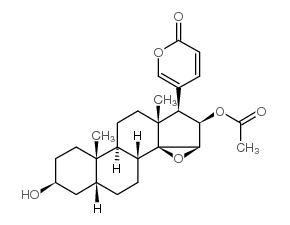
Cinobufagin
CAS No. 470-37-1
Cinobufagin( Cinobufagin | Cinobufagine | Cino-bufagin )
Catalog No. M18578 CAS No. 470-37-1
Cinobufagin is a selective Na+/K+-ATPase inhibitor. The activity of Cinobufagin is same as ouabain.
Purity : >98% (HPLC)
 COA
Datasheet
HNMR
HPLC
MSDS
Handing Instructions
COA
Datasheet
HNMR
HPLC
MSDS
Handing Instructions
| Size | Price / USD | Stock | Quantity |
| 2MG | 57 | In Stock |


|
| 5MG | 87 | In Stock |
|
| 10MG | 132 | In Stock |
|
| 25MG | 223 | In Stock |
|
| 50MG | 332 | In Stock |
|
| 100MG | 489 | In Stock |
|
| 200MG | 698 | In Stock |
|
| 500MG | 1044 | In Stock |
|
| 1G | Get Quote | In Stock |
|
Biological Information
-
Product NameCinobufagin
-
NoteResearch use only, not for human use.
-
Brief DescriptionCinobufagin is a selective Na+/K+-ATPase inhibitor. The activity of Cinobufagin is same as ouabain.
-
DescriptionCinobufagin is a cardiotoxic bufanolide steroid secreted by the Asiatic toad Bufo gargarizans. It has similar effects to digitalis and is used in traditional Chinese medicine. Cinobufagin has been shown to have clinical applications in cancer treatment as well as immunomodulatory and analgesic properties. Cinobufagin induces apoptosis of osteosarcoma cells through inactivation of Notch signaling. Cinobufagin induces autophagy-mediated cell death in human osteosarcoma U2OS cells through the ROS/JNK/p38 signaling pathway.
-
In VitroCell Proliferation Assay Cell Line:OCM1 cell Concentration:30,100,300 nMIncubation Time:7 daysResult:Exerted potent cytotoxic in OCM1 cells with an IC50 of 8.023 nM. Apoptosis Analysis Cell Line:OCM1 cell Concentration:30,100,300 nM Incubation Time:24 hours Result:Induced cell apoptosis and upregulate the expression levels of cleaved caspase-3, cleaved poly(ADP-ribose) polymerase (PARP), and cleaved caspase-9. Activated the intrinsic mitochondrial apoptosis pathway, which was demonstrated by increased cell apoptosis with increased expression of Bad and Bax, decreased expression of Bcl-2 and Bcl-xl, and reduced mitochondrial membrane potential (MMP).
-
In VivoAnimal Model:OCM1 cells tumor xenograft in Nu/Nu nude mice Dosage:5 mg/kg Administration:Intraperitoneal injection (i.p.), once a day for 10 days Result:Made the tumors grew more slowly than those treated with intraperitoneal injection of saline or untreated. Increased the expression of caspase-3 and PARP in tumor tissues and decreased Bcl-2 and Bcl-xl expression in mouse tumor tissues and increased expression of Bad and Bax. Animal Model:U87MG-EGFR subcutaneous and intracranial xenograft model Dosage:5 mg/kg Administration:Intraperitoneal injection (i.p.), once a day for 10 days Result:Decreased the luminescence intensity of brain tumor about 70%.Decreased p-EGFR, p-STAT3, and p-Akt levels in the intracranial tumors as compared with the vehicles.Decreased Ki67 and active caspase-3 immunostaining of intracranial tumors.
-
SynonymsCinobufagin | Cinobufagine | Cino-bufagin
-
PathwayMicrobiology/Virology
-
TargetAntifungal
-
RecptorNa+/K+-ATPase
-
Research AreaCancer
-
Indication——
Chemical Information
-
CAS Number470-37-1
-
Formula Weight442.55
-
Molecular FormulaC26H34O6
-
Purity>98% (HPLC)
-
SolubilityDMSO : ≥ 43 mg/mL; 97.17 mM
-
SMILESCC(=O)O[C@@H]1[C@@H]([C@]2(CC[C@H]3[C@H]([C@]42[C@@H]1O4)CC[C@H]1[C@@]3(CC[C@@H](C1)O)C)C)c1coc(=O)cc1
-
Chemical Name(1R,2R,2aR,3aS,3bS,5aR,7S,9aS,9bR,11aS)-7-hydroxy-9a,11a-dimethyl-1-(2-oxo-2H-pyran-4-yl)hexadecahydronaphtho[1',2':6,7]indeno[1,7a-b]oxiren-2-yl acetate
Shipping & Storage Information
-
Storage(-20℃)
-
ShippingWith Ice Pack
-
Stability≥ 2 years
Reference
1. Toma S, et al. Xenobiotica. 1987 Oct;17(10):1195-202.
molnova catalog



related products
-
Safinamide mesylate
Safinamide Mesylate, a mesylate salt of Safinamide, can reversibly and specifically inhibit MAO-B (IC50: 98 nM), has 5918-fold selectivity against MAO-A.
-
Ametoctradin
Ametoctradin is an inhibitor of the Qo site of mitochondrial respiratory complex III.
-
Antibacterial agent ...
Antibacterial agent 132 showed antimicrobial activity against C. parapsilosis (ATCC 22019) and C. krusei (ATCC 6258) with MIC90 values of <0.06 μg/mL and 62.50 μg/mL, respectively.
