


 Cart
Cart
 sales@molnova.com


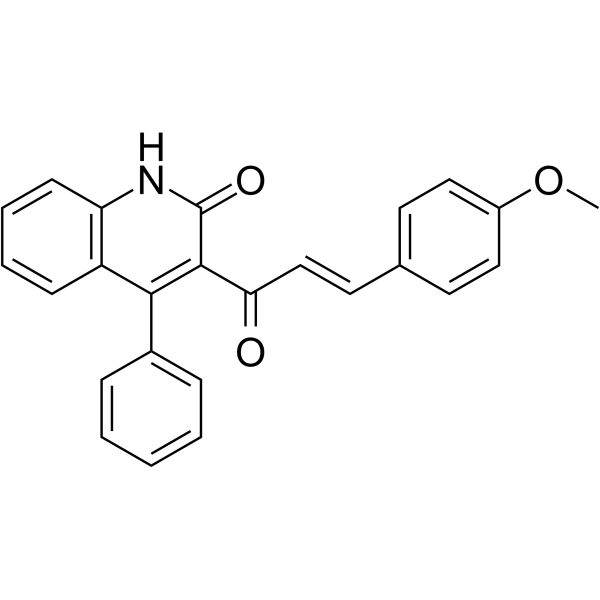
Ceranib-2
CAS No. 1402830-75-4
Ceranib-2( 3-[(E)-3-(4-hydroxyphenyl)prop-2-enoyl]-4-phenyl-1H-quinolin-2-one )
Catalog No. M26102 CAS No. 1402830-75-4
Ceranib-2 is an inhibitor of ceramidase with an IC50 of 28 μM in SKOV3 cells.
Purity : >98% (HPLC)
 COA
Datasheet
HNMR
HPLC
MSDS
Handing Instructions
COA
Datasheet
HNMR
HPLC
MSDS
Handing Instructions
| Size | Price / USD | Stock | Quantity |
| 5MG | 42 | In Stock |


|
| 10MG | 80 | In Stock |
|
| 25MG | 170 | In Stock |
|
| 50MG | 282 | In Stock |
|
| 100MG | 462 | In Stock |
|
| 200MG | Get Quote | In Stock |
|
| 500MG | Get Quote | In Stock |
|
| 1G | Get Quote | In Stock |
|
Biological Information
-
Product NameCeranib-2
-
NoteResearch use only, not for human use.
-
Brief DescriptionCeranib-2 is an inhibitor of ceramidase with an IC50 of 28 μM in SKOV3 cells.
-
DescriptionCeranib-2 is an inhibitor of ceramidase with an IC50 of 28 μM in SKOV3 cells. Ceranib-2 decreases levels of sphingosine and S1P, induces cell apoptosis and exhibits anticancer activity.(In Vitro):In SKOV3 cells, Ceranib-2 (28 μM) decreases with 50% inhibition and induces the accumulation of multiple ceramide species. Ceranib-2 (10 nM-10 μM) inhibits cell proliferation and survival with an IC50 value of 0.73 μM. Ceranib-2 (0.75-1.5 μM) accumulates cells in the sub-G1. G2 and S phases of the cell cycle are concomitantly reduced in the number of cells in the G1 phase at the dose of 0.75 μM.(In Vivo):In female Balb/c mice, Ceranib-2 (20-50 mg/kg; i.p.) delays tumor growth without hematologic suppression in a syngeneic tumor model. Ceranib-2 (50 mg/kg; i.p.) increases the circulating levels, reaching a peak plasma concentration of approximately 40 μM at 2 hr.
-
In VitroCeranib-2 (10 nM-10 μM; 72 hours; SKOV3 cells) treatment inhibits cell proliferation and/or survival with an IC50 value of 0.73 μM.Ceranib-2 (0.75-1.5 μM; 48 hours; SKOV3 cells) treatment causes accumulation of cells in the sub-G1 (apoptosis), G2 and S (0.75 μM only) phases of the cell cycle, concomitant with reductions in the number of cells in G1 phase.Ceranib-2 produces a dose-dependent decrease in ceramidase activity, with 50% inhibition at 28 μM, induces the accumulation of multiple ceramide species, and decreases levels of sphingosine and S1P.Cell Proliferation Assay Cell Line:SKOV3 cells Concentration:10 nM-10 μM Incubation Time:72 hours Result:Cell proliferation and/or survival were inhibited with an IC50 value of 0.73 μM for Ceranib-2.Cell Cycle Analysis Cell Line:SKOV3 cells Concentration:0.75 μM, or 1.5 μM Incubation Time:48 hours Result:Induced cell-cycle arrest and cell death.
-
In VivoCeranib-2 (20-50 mg/kg; intraperitoneal injection; daily for 5 days per week; for 3 weeks; female Balb/c mice) treatment delays tumor growth in a syngeneic tumor model without hematologic suppression or overt signs of toxicity.Intraperitoneal administration of 50 mg/kg Ceranib-2 results in progressive increases in its circulating levels, reaching a peak plasma concentration of approximately 40 μM at the 2 hr time point. Ceranib-2 appears to be cleared with a half-life of less than 2 hr. Animal Model:Female Balb/c mice injected with JC murine mammary adenocarcinoma cells Dosage:20 mg/kg or 50 mg/kg Administration:Intraperitoneal injection; daily for 5 days per week; for 3 weeks Result:Delayed tumor growth in a syngeneic tumor model.
-
Synonyms3-[(E)-3-(4-hydroxyphenyl)prop-2-enoyl]-4-phenyl-1H-quinolin-2-one
-
PathwayApoptosis
-
TargetApoptosis
-
RecptorPEGs
-
Research Area——
-
Indication——
Chemical Information
-
CAS Number1402830-75-4
-
Formula Weight381.431
-
Molecular FormulaC25H19NO3
-
Purity>98% (HPLC)
-
SolubilityIn Vitro:?DMSO : 50 mg/mL (131.09 mM)
-
SMILESCOc1ccc(\C=C\C(=O)c2c(-c3ccccc3)c3ccccc3[nH]c2=O)cc1
-
Chemical Name——
Shipping & Storage Information
-
Storage(-20℃)
-
ShippingWith Ice Pack
-
Stability≥ 2 years
Reference
1.An S, et al. Small-molecule PROTACs: An emerging and promising approach for the development of targeted therapy drugs. EBioMedicine. 2018 Oct;36:553-562.
molnova catalog



related products
-
BC 11 hydrobromide
BC 11 hydrobromide is a selective TMPRSS2 and urokinase (uPA) inhibitor.BC-11 induces diminished mitochondrial activity, promotes reactive oxygen species production, and promotes apoptosis, and can be used in the study of breast cancer.
-
Exisulind
Exisulind induces apoptosis through the activation of protein kinase G (PKG). Exisulind exhibits antineoplastic activity in solid tumour and haematological cancer cell lines and is an inhibitor of tumour growth in rodent models of colon, prostate, bladder, mammary and lung cancer.
-
GUT-70
GUT-70 is a tricyclic coumarin derived from Calophyllum brasiliense, markedly reduces cell proliferation.
