


 Cart
Cart
 sales@molnova.com


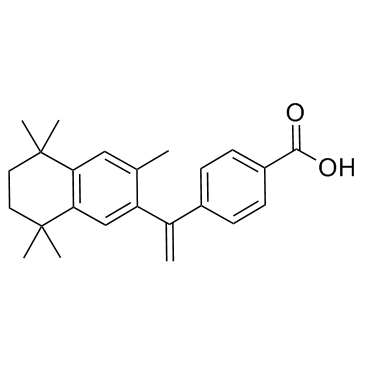
Bexarotene
CAS No. 153559-49-0
Bexarotene( LG 100069 | LGD 1069 | Ro 26-4455 | SR 11247 )
Catalog No. M12167 CAS No. 153559-49-0
Bexarotene is a retinoid specifically selective for retinoid X receptors, used as an oral antineoplastic agent in the treatment of cutaneous T-cell lymphoma.
Purity : >98% (HPLC)
 COA
Datasheet
HNMR
HPLC
MSDS
Handing Instructions
COA
Datasheet
HNMR
HPLC
MSDS
Handing Instructions
| Size | Price / USD | Stock | Quantity |
| 25MG | 40 | In Stock |


|
| 50MG | 56 | In Stock |
|
| 100MG | 82 | In Stock |
|
| 200MG | 111 | In Stock |
|
| 500MG | 235 | In Stock |
|
| 1G | Get Quote | In Stock |
|
Biological Information
-
Product NameBexarotene
-
NoteResearch use only, not for human use.
-
Brief DescriptionBexarotene is a retinoid specifically selective for retinoid X receptors, used as an oral antineoplastic agent in the treatment of cutaneous T-cell lymphoma.
-
DescriptionBexarotene is a retinoid specifically selective for retinoid X receptors, used as an oral antineoplastic agent in the treatment of cutaneous T-cell lymphoma.(In Vitro):Bexarotene selectively binds and activates RXR subtypes with Kd=14±2 nM, 21±4 nM, and 29±7 nM for RXRα, RXRβ, and RXRγ subtypes. Bexarotene is effective in limiting the proliferation of leukemic (HL-60) cells. Bexarotene inhibits the proliferation of HL-60 cells by 37% at 1 μM. Bexarotene monotherapy of cells shows an antiproliferative effect at a high dose, and the IC50s aere 40.62±0.45 μM (PC3) and 50.20±4.10 μM (DU145). Bexarotene (20 and 40 μM) and Docetaxel (5 and 10 μM) exhibit a synergistic effect on the inhibition of PC3 and DU145 cell proliferation.Bexarotene (20 and 40 μM) represses cyclin D1 and cyclin D3 expression in PC3 and DU145 cells. (In Vivo):Bexarotene (1 mg/kg/day) is effective in blocking the development of behavioral deficits and dopamine neuron degeneration in a rat model of Parkinson’s disease (PD) producing significantly reduced changes in both triglycerides and T4 serum. Bexarotene is an effective preventive agent against lung tumor growth and progression. Bexarotene ((100 mg/kg by gavage) inhibits both tumor multiplicity and tumor volume in mice of all three genotypes (p53wt/wtK-raswt/wt, p53val135/wtK-raswt/wt, or p53wt/wtK-rasko/wt). Bexarotene reduces the progression of adenoma to adenocarcinoma by ~50% in both p53wt/wtK-rasko/wt and p53wt/wtK-raswt/wt mice.
-
In VitroCell Proliferation Assay Cell Line:The human PCa androgen-independent cell lines PC3 and DU145Concentration:5, 10, 20, 30, 40 μM for PC3 cells; 1, 5, 10, 20, 40 μM for DU145 cells.Incubation Time:24 and 48?hoursResult:Showed an antiproliferative effect with the IC50s were 40.62±0.45?μM (PC3) and 50.20±4.10?μM (DU145).?Cell Viability AssayCell Line:PC3 and DU145 cellsConcentration:20 and 40?μMIncubation Time:24 or 48?hours Result:Decreased cyclin D1, and cyclin E2 after 24?hours treatment.?Not only decreased the expression of cyclin D1 and cyclin E2 but repressed cyclin B1 and CDK1 expression after 48?hours treatment.
-
In VivoAnimal Model:UL53-3 mice (p53wt/wtK-raswt/wt, p53val135/wtK-raswt/wt, or p53wt/wtK-rasko/wt)Dosage:100?mg/kg Administration:Gavage with 18 gage of gavage-needle, 0.1?mL per mouse per day, 5 times a week, continued for 12 weeks Result:Inhibited both tumor multiplicity and tumor volume in mice of all three genotypes.
-
SynonymsLG 100069 | LGD 1069 | Ro 26-4455 | SR 11247
-
PathwayMetabolic Enzyme/Protease
-
TargetRetinoid Receptor
-
RecptorRXR
-
Research AreaCancer
-
Indication——
Chemical Information
-
CAS Number153559-49-0
-
Formula Weight348
-
Molecular FormulaC24H28O2
-
Purity>98% (HPLC)
-
SolubilityDMSO: 8 mg/mL (22.98 mM)
-
SMILESO=C(O)C1=CC=C(C(C2=C(C)C=C3C(C)(C)CCC(C)(C)C3=C2)=C)C=C1
-
Chemical Name4-(1-(3,5,5,8,8-pentamethyl-5,6,7,8-tetrahydronaphthalen-2-yl)vinyl)benzoic acid
Shipping & Storage Information
-
Storage(-20℃)
-
ShippingWith Ice Pack
-
Stability≥ 2 years
Reference
1. Zhang C, et al. Clin Y Res, 2002, 8(5), 1234-1240.
molnova catalog



related products
-
LE135
LE135 is a potent RAR antagonist that binds selectively to RARα (Ki of 1.4 μM) and RARβ (Ki of 220 nM), showing higher affinity for RARβ.
-
BMS493
BMS493 is an inverse agonist of the pan-retinoic acid receptor (RAR) that inhibits retinoic acid-induced differentiation, enhances the interaction of nuclear co-inhibitors with RARs, attenuates RA signaling, potentiates TPP-induced toxicity, and inhibits the increase in phospholipase A2 activity.
-
Acitretin
Acitretin(Ro 10-1670) is a second-generation, systemic retinoid that has been used in the treatment of psoriasis.
