


 Cart
Cart
 sales@molnova.com


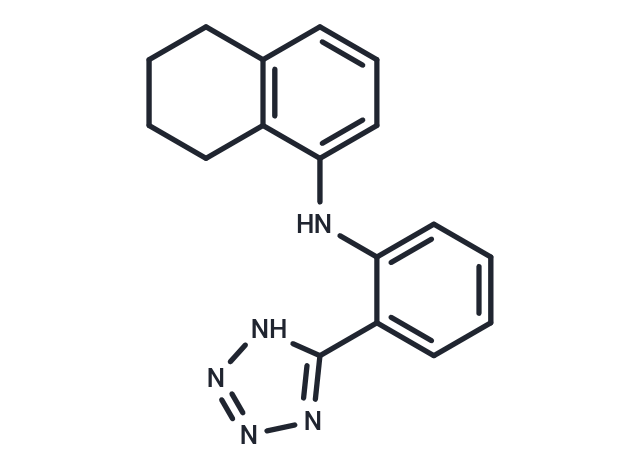
BL-1249
CAS No. 18200-13-0
BL-1249( —— )
Catalog No. M33294 CAS No. 18200-13-0
BL-1249 is a selective and potent non-steroidal potassium channel activator with anti-inflammatory activity that activates K2P2.1 (TREK-1) and K2P10.1 (TREK-2).
Purity : >98% (HPLC)
 COA
Datasheet
HNMR
HPLC
MSDS
Handing Instructions
COA
Datasheet
HNMR
HPLC
MSDS
Handing Instructions
| Size | Price / USD | Stock | Quantity |
| 2MG | 73 | Get Quote |


|
| 5MG | 107 | Get Quote |
|
| 10MG | 170 | Get Quote |
|
| 25MG | 250 | Get Quote |
|
| 50MG | 342 | Get Quote |
|
| 100MG | 588 | Get Quote |
|
| 500MG | 1215 | Get Quote |
|
| 1G | Get Quote | Get Quote |
|
Biological Information
-
Product NameBL-1249
-
NoteResearch use only, not for human use.
-
Brief DescriptionBL-1249 is a selective and potent non-steroidal potassium channel activator with anti-inflammatory activity that activates K2P2.1 (TREK-1) and K2P10.1 (TREK-2).
-
DescriptionBL-1249 is a nonsteroidal anti-inflammatory agent (NSAID) and a potassium channel activator. BL-1249 potently activates K2P2.1 (TREK-1) and K2P10.1 (TREK-2) with EC50 values of 5.5 μM and 8.0 μM, respectively. BL-1249 extracellular application activates all TREK subfamily members but has no effect on other K2P subfamilies. BL-1249 exhibits more selective for the bladder (EC50 of 1.26 μM) than vascular tissue (EC50 of 21.0 μM).
-
In VitroBL-1249 produces a concentration-dependent membrane hyperpolarization of cultured human bladder myocytes, assessed as either a reduction in fluorescence of the voltage-sensitive dye bis-(1,2-dibutylbarbituric acid)trimethine oxonol (EC50 of 1.26 μM) or by direct electrophysiological measurement EC50 of 1.49 μM). BL-1249 produced a concentration-dependent hyperpolarization with an EC50 of 21.0 μM in human aortic smooth muscle cells.In in vitro organ bath experiments, BL-1249 produces a concentration-dependent relaxation of 30 mM KCl-induced contractions in rat bladder strips (EC50 of 1.12 μM), yet has no effect on aortic strips up to the highest concentration tested (10 μM). The bladder relaxation produced by BL-1249 is partially blocked by Ba2+ (1 and 10 mM).BL-1249 is a selective agonist of the TREK subfamily when applied extracellularly, having preferential action on K2P2.1(TREK-1) and K2P10.1(TREK-2) over K2P4.1(TRAAK) and establish that its mechanism of action relies on gating at the selectivity filter C-type gate.
-
In VivoBL-1249 (1 mg/kg) inhibits isovolumic bladder contractions in vivo. The short duration of the effect of BL-1249 on bladder contraction ( 30 min) is likely due to a fast elimination half-life of the compound after i.v. administration (0.69 h). BL-1249 (1 mg/kg) has little effect on mean arterial blood pressure, an observation again consistent with the in vitro bladder to vascular relaxant selectivity.
-
Synonyms——
-
PathwayCell Cycle/DNA Damage
-
TargetPotassium Channel
-
RecptorPotassium Channel
-
Research Area——
-
Indication——
Chemical Information
-
CAS Number18200-13-0
-
Formula Weight291.35
-
Molecular FormulaC17H17N5
-
Purity>98% (HPLC)
-
SolubilityIn Vitro:?DMSO : 50 mg/mL (171.61 mM; Ultrasonic (<60°C)
-
SMILESC1CCc2c(C1)cccc2Nc1ccccc1-c1nnn[nH]1
-
Chemical Name——
Shipping & Storage Information
-
Storage(-20℃)
-
ShippingWith Ice Pack
-
Stability≥ 2 years
Reference
1. Tertyshnikova S, et al. BL-1249 [(5,6,7,8-tetrahydro-naphthalen-1-yl)-[2-(1H-tetrazol-5-yl)-phenyl]-amine]: a putative potassium channel opener with bladder-relaxant properties. J Pharmacol Exp Ther. 2005 Apr;313(1):250-9.?
molnova catalog



related products
-
RY785
RY785 is a potent and selective inhibitor of voltage-gated potassium channel such as KV2.2 (IC50 = 50 nM). RY785 may be used in pain relief studies.
-
GAL-021 sulfate
GAL-021 sulfate is a BKCa channel blocker that inhibits the analgesic effects of opioids and is used in the study of respiratory control diseases.
-
Pinacidil
Pinardil (P-1134, S-1230) is a guanidine that opens potassium channels and directly dilates peripheral blood vessels in small arteries, lowering blood pressure and peripheral resistance and producing fluid retention.
