


 Cart
Cart
 sales@molnova.com


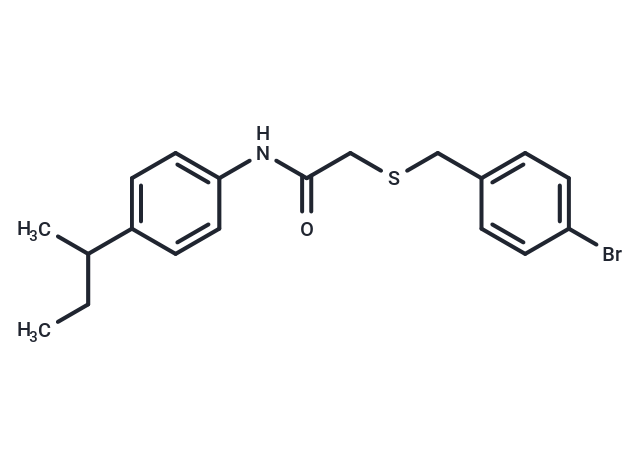
AZ12216052
CAS No. 1290628-31-7
AZ12216052( —— )
Catalog No. M34169 CAS No. 1290628-31-7
AZ12216052 is a GRP8 antagonist with anxiolytic and anti-inflammatory activity and can be used to study obesity and metabolic disorders.
Purity : >98% (HPLC)
 COA
Datasheet
HNMR
HPLC
MSDS
Handing Instructions
COA
Datasheet
HNMR
HPLC
MSDS
Handing Instructions
| Size | Price / USD | Stock | Quantity |
| 2MG | 79 | Get Quote |


|
| 5MG | 117 | Get Quote |
|
| 10MG | 188 | Get Quote |
|
| 25MG | 319 | Get Quote |
|
| 50MG | 474 | Get Quote |
|
| 100MG | 660 | Get Quote |
|
| 500MG | Get Quote | Get Quote |
|
| 1G | Get Quote | Get Quote |
|
Biological Information
-
Product NameAZ12216052
-
NoteResearch use only, not for human use.
-
Brief DescriptionAZ12216052 is a GRP8 antagonist with anxiolytic and anti-inflammatory activity and can be used to study obesity and metabolic disorders.
-
DescriptionAZ 12216052 is a mGluR8 positive allosteric modulator, and helps mGluR8 modulate signaling inputing to retinal ganglion cells. AZ 12216052 exhibits antianxiety effect.
-
In VitromGluR8 may modulates the synaptic inputs to retinal ganglion cells.AZ 12216052 (10 μM) enhances the peak excitatory currents of ON-, OFF- currents in ON-OFF-ganglion cells, with a dependent way on the intensity of the light stimuli.AZ 12216052 shows impact of cell differentiation and (0.01-1 μM; 24-48 h) reduces Dox-induced human neuroblastoma SH-SY5Y cell damage partially.AZ 12216052 stimulates proliferation and attenuates staurosporine (St)- and doxorubicin (Dox)-induced toxicity in UN-SH-SY5Y cells.AZ12216052 (10 μM) enhances glutamate activity of human mGluR8b receptor expressed in GHEK cells.Cell Viability Assay Cell Line:UN- and RA-SH-SY5Y cells Concentration:0.01-1 μM Incubation Time:48 hours Result:Increased cell viability at 0.1 μM, and protected undifferentiated neuroblastoma cells against damaging effects of Iri or Cis.
-
In VivoAZ 12216052 (10 mg/kg; i.p.; 2 h prior to testing) reduces measures of anxiety, without affecting the velocity of the mice.AZ12216052 (10 mg/kg; i.p.; single dose) exhibits remaining anxiolytic effects, might involve mGluR4 in mGluR8?/? mice, as the mGluR4 PAM (Positive Allosteric Modulator) VU 0155041 also reduces measures of anxiety in wild-type mice.Animal Model:WT and Apolipoprotein E-deficient (Apoe?/?) mice (C57BL/6J, 2-month-old) in the elevated zero maze Dosage:10 mg/kg Administration:Intraperitoneal injection; singel dose, 2 h prior to testing Result:Reduced measures of anxiety in the elevated zero maze without affecting the velocity of the mice.
-
Synonyms——
-
PathwayCell Cycle/DNA Damage
-
TargetGPR
-
RecptorGPR
-
Research Area——
-
Indication——
Chemical Information
-
CAS Number1290628-31-7
-
Formula Weight392.35
-
Molecular FormulaC19H22BrNOS
-
Purity>98% (HPLC)
-
SolubilityIn Vitro:?DMSO : 100 mg/mL (254.87 mM; Ultrasonic )
-
SMILESCCC(C)c1ccc(NC(=O)CSCc2ccc(Br)cc2)cc1
-
Chemical Name——
Shipping & Storage Information
-
Storage(-20℃)
-
ShippingWith Ice Pack
-
Stability≥ 2 years
Reference
1. Reed BT, et al. Differential modulation of retinal ganglion cell light responses by orthosteric and allosteric metabotropic glutamate receptor 8 compounds. Neuropharmacology. 2013 Apr;67:88-94.?
molnova catalog



related products
-
WAY-622024
WAY-622024 is an agonist of the orphan human GPCR GPR109B.
-
AMG 837 calcium hydr...
AMG 837 calcium hydrate is a potent GPR40 agonist with an EC50 of 13 nM. AMG 837 calcium hydrate also shows highly selective over GPR41, GPR43, and GPR120 (EC50 > 10,000 nM).
-
FTBMT
FTBMT is a selective GPR52 agonist (EC50: 75 nM) and it also has antipsychotic and procognitive properties.
