


 Cart
Cart
 sales@molnova.com


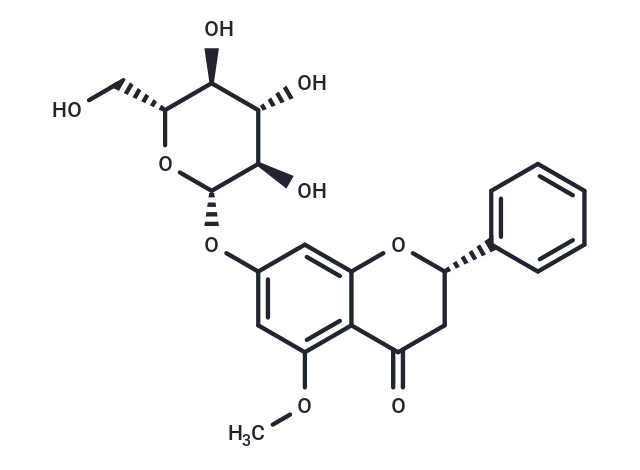
5-MethoxyPinocembroside
CAS No. 1450878-89-3
5-MethoxyPinocembroside( —— )
Catalog No. M33196 CAS No. 1450878-89-3
5-MethoxyPinocembroside is a flavonoid isolated from the leaves of [Moringa oleifera].
Purity : >98% (HPLC)
 COA
Datasheet
HNMR
HPLC
MSDS
Handing Instructions
COA
Datasheet
HNMR
HPLC
MSDS
Handing Instructions
| Size | Price / USD | Stock | Quantity |
| 2MG | 216 | Get Quote |


|
| 5MG | 283 | Get Quote |
|
| 10MG | 493 | Get Quote |
|
| 25MG | 771 | Get Quote |
|
| 500MG | Get Quote | Get Quote |
|
| 1G | Get Quote | Get Quote |
|
Biological Information
-
Product Name5-MethoxyPinocembroside
-
NoteResearch use only, not for human use.
-
Brief Description5-MethoxyPinocembroside is a flavonoid isolated from the leaves of [Moringa oleifera].
-
Description5-MethoxyPinocembroside is a flavonoid isolated from Penthorumchinense Pursh.
-
In Vitro——
-
In Vivo——
-
Synonyms——
-
PathwayOthers
-
TargetOther Targets
-
RecptorOthers
-
Research Area——
-
Indication——
Chemical Information
-
CAS Number1450878-89-3
-
Formula Weight432.42
-
Molecular FormulaC22H24O9
-
Purity>98% (HPLC)
-
Solubility——
-
SMILESO(C)C1=C2C(O[C@@H](CC2=O)C3=CC=CC=C3)=CC(O[C@@H]4O[C@H](CO)[C@@H](O)[C@H](O)[C@H]4O)=C1
-
Chemical Name——
Shipping & Storage Information
-
Storage(-20℃)
-
ShippingWith Ice Pack
-
Stability≥ 2 years
Reference
molnova catalog



related products
-
Amaranth
Amaranth as a potential component of lifestyle modification to improve cardiovascular risk profiles by modifying cardiovascular risk factors such as cholesterol diabetes and hypertension.
-
(5S,6S,7S,8R)-8-Chlo...
8-Chloro-2-(2-phenylethyl)-5,6,7-trihydroxy-5,6,7,8-tetrahydrochromone, a chromone derivative, is present in the methanol extract obtained from withered wood of Aquilaria sinensis.
-
AA92593
AA92593 has been used as a selective inhibitor of melanopsin.The involvement of melanopsin in the regulation of melatonin was also determined by using a specific inhibitor AA92593 and by inhibiting melanopsin-induced phospholipase C activation.
