


 Cart
Cart
 sales@molnova.com


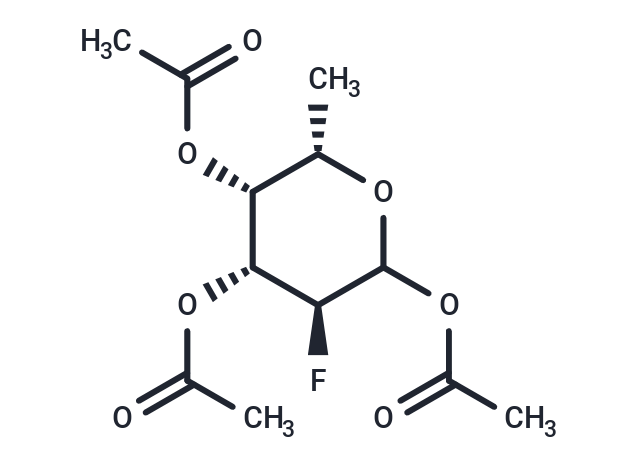
2F-Peracetyl-Fucose
CAS No. 188783-78-0
2F-Peracetyl-Fucose( —— )
Catalog No. M35005 CAS No. 188783-78-0
2F-Peracetyl-Fucose (1,3,4-Tri-O-acetyl-2-deoxy-2-fluoro-L-fucopyranos) is a potent fucosyltransferase (FUT) inhibitor that suppresses salivary acidification and fucosylation in an in vitro inflammatory model.
Purity : >98% (HPLC)
 COA
Datasheet
HNMR
HPLC
MSDS
Handing Instructions
COA
Datasheet
HNMR
HPLC
MSDS
Handing Instructions
| Size | Price / USD | Stock | Quantity |
| 5MG | 47 | Get Quote |


|
| 500MG | Get Quote | Get Quote |
|
| 1G | Get Quote | Get Quote |
|
Biological Information
-
Product Name2F-Peracetyl-Fucose
-
NoteResearch use only, not for human use.
-
Brief Description2F-Peracetyl-Fucose (1,3,4-Tri-O-acetyl-2-deoxy-2-fluoro-L-fucopyranos) is a potent fucosyltransferase (FUT) inhibitor that suppresses salivary acidification and fucosylation in an in vitro inflammatory model.
-
Description2F-Peracetyl-Fucose (1,3,4-Tri-O-acetyl-2-deoxy-2-fluoro-L-fucopyranos) acts as a potent fucosyltransferase (FUT) inhibitor.
-
In Vitro——
-
In Vivo——
-
Synonyms——
-
PathwayOthers
-
TargetOther Targets
-
RecptorOthers
-
Research Area——
-
Indication——
Chemical Information
-
CAS Number188783-78-0
-
Formula Weight292.26
-
Molecular FormulaC12H17FO7
-
Purity>98% (HPLC)
-
SolubilityIn Vitro:?DMSO : 100 mg/mL (342.16 mM; Ultrasonic )
-
SMILESC[C@@H]1OC(OC(C)=O)[C@@H](F)[C@H](OC(C)=O)[C@@H]1OC(C)=O
-
Chemical Name——
Shipping & Storage Information
-
Storage(-20℃)
-
ShippingWith Ice Pack
-
Stability≥ 2 years
Reference
1. Martina Zimmermann, et al. Impact of Acetylated and Non-Acetylated Fucose Analogues on IgG Glycosylation. Antibodies (Basel). 2019 Jan 10;8(1):9.?
molnova catalog



related products
-
C-Peptide, dog
C-Peptide, dog is a component of proinsulin, released from pancreatic beta cells into blood together with insulin. The C-peptide of proinsulin is important for the biosynthesis of insulin but has for a long time been considered to be biologically inert.
-
Aristolochic Acid
Aristolochic acids are a family of carcinogenic, mutagenic, and nephrotoxic compounds commonly found in the Birthwort (Aristolochiaceae) family of plants.
-
Glycyl-glycine
Glycylglycine (Gly-Gly) is a dipeptide used in biochemical research. It is the simplest of all dipeptides and is used as a starting template for preparation of more complex peptides. Glycine is involved in the body's production of DNA phospholipids and collagen and in the release of energy.
