


 Cart
Cart
 sales@molnova.com


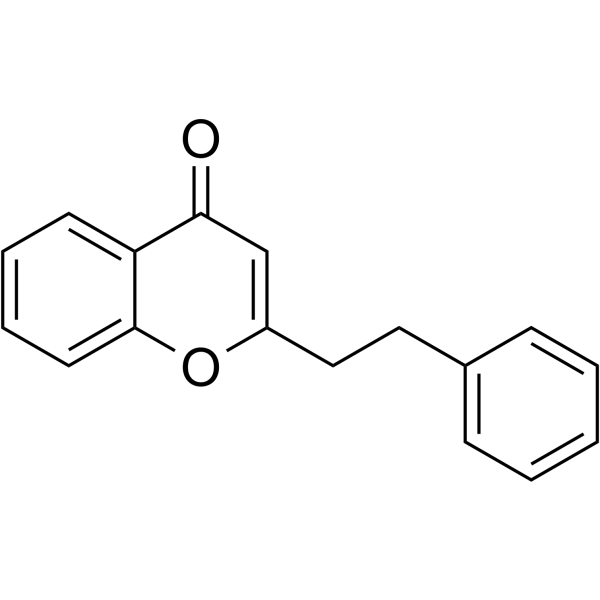
2-(2-Phenylethyl)chromone
CAS No. 61828-53-3
2-(2-Phenylethyl)chromone( Flidersiachromone )
Catalog No. M29258 CAS No. 61828-53-3
2-(2-Phenylethyl)chromone is a natural product isolated from the herbs of Aquilaria sinensis.
Purity : >98% (HPLC)
 COA
Datasheet
HNMR
HPLC
MSDS
Handing Instructions
COA
Datasheet
HNMR
HPLC
MSDS
Handing Instructions
| Size | Price / USD | Stock | Quantity |
| 5MG | 81 | Get Quote |


|
| 10MG | 126 | Get Quote |
|
| 25MG | 207 | Get Quote |
|
| 50MG | 315 | Get Quote |
|
| 100MG | Get Quote | Get Quote |
|
| 200MG | Get Quote | Get Quote |
|
| 500MG | Get Quote | Get Quote |
|
| 1G | Get Quote | Get Quote |
|
Biological Information
-
Product Name2-(2-Phenylethyl)chromone
-
NoteResearch use only, not for human use.
-
Brief Description2-(2-Phenylethyl)chromone is a natural product isolated from the herbs of Aquilaria sinensis.
-
Description2-(2-Phenylethyl)chromone is a natural product isolated from the herbs of Aquilaria sinensis.
-
In Vitro——
-
In Vivo——
-
SynonymsFlidersiachromone
-
PathwayOthers
-
TargetOther Targets
-
Recptor——
-
Research Area——
-
Indication——
Chemical Information
-
CAS Number61828-53-3
-
Formula Weight250.29
-
Molecular FormulaC17H14O2
-
Purity>98% (HPLC)
-
SolubilityIn Vitro:?DMSO : 100 mg/mL (399.54 mM)
-
SMILESO=C1c(cccc2)c2OC(CCc2ccccc2)=C1
-
Chemical Name——
Shipping & Storage Information
-
Storage(-20℃)
-
ShippingWith Ice Pack
-
Stability≥ 2 years
Reference
molnova catalog



related products
-
Lipopolysaccharides,...
Lipopolysaccharides, Escherichiacoli (E. coli O111:B4) are derived from Escherichia coli O111:B4 and are a unique component of the cell wall of Gram-negative bacteria.
-
BAPTA-AM
BAPTA-AM is a selective, membrane-permeable calcium chelator.
-
Dibutyl maleate
Dibutyl maleate is a diester of the Maleic Acid and can be used as an intermediate of the synthesis of antibacterial compounds.
