


 Cart
Cart
 sales@molnova.com


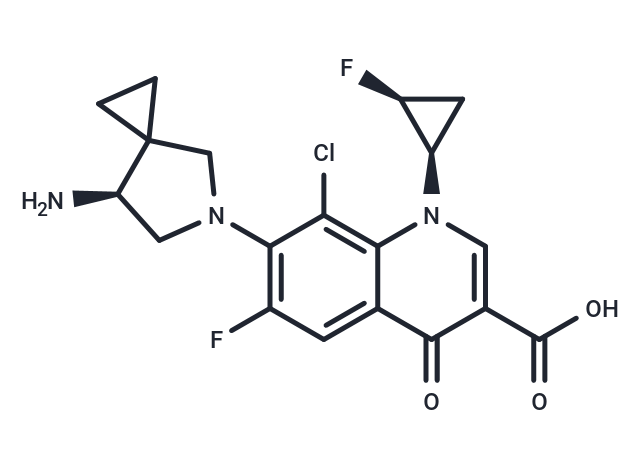
Sitafloxacin
CAS No. 127254-12-0
Sitafloxacin( —— )
Catalog No. M35721 CAS No. 127254-12-0
Sitafloxacin (Sitafloxacin anhydrous) is an orally active fluoroquinolone antibiotic with broad-spectrum antimicrobial activity.Sitafloxacin has been used in the study of respiratory tract infections and urinary tract infections.
Purity : >98% (HPLC)
 COA
Datasheet
HNMR
HPLC
MSDS
Handing Instructions
COA
Datasheet
HNMR
HPLC
MSDS
Handing Instructions
| Size | Price / USD | Stock | Quantity |
| 2MG | 185 | In Stock |


|
| 5MG | 281 | In Stock |
|
| 10MG | 546 | In Stock |
|
| 25MG | 1104 | In Stock |
|
| 50MG | 2070 | In Stock |
|
| 100MG | 2673 | In Stock |
|
| 500MG | Get Quote | In Stock |
|
| 1G | Get Quote | In Stock |
|
Biological Information
-
Product NameSitafloxacin
-
NoteResearch use only, not for human use.
-
Brief DescriptionSitafloxacin (Sitafloxacin anhydrous) is an orally active fluoroquinolone antibiotic with broad-spectrum antimicrobial activity.Sitafloxacin has been used in the study of respiratory tract infections and urinary tract infections.
-
DescriptionSitafloxacin (DU6859a) is a potent, orally active fluoroquinolone antibiotic. Sitafloxacin shows antichlamydial activity and antibacterial activities against a broad range of gram-positive and gram-negative bacteria, including anaerobic bacteria, as well as against atypical pathogens. Sitafloxacin can be used for the research of respiratory tract infection and urinary tract infection.
-
In VitroSitafloxacin (DU6859a) shows antibacterial activities with MIC of 0.03, 0.12, 0.06 mg/L for wild-type ATCC 49619, gyrA mutant SP39, parCmutant 1026523 streptococcus pneumoniae stran, respectively. Sitafloxacin (DU6859a) shows antibacterial activities for quinolone-susceptible strains of streptococcus pneumoniae with MIC of 0.03, 0.03 mg/L for EG 00093 and EG 00218 strain, respectively.Sitafloxacin (DU6859a) shows inhibition for DNA gyrase and topoisomerase IV (TopoIV) with >IC50s of 4.38, 3.12 mg/L, respectively.
-
In VivoSitafloxacin (DU-6859a) (12.5-100 mg/kg; i.g.; daily for 4 weeks; BALB/c female mice) has antibacterial activity. M. ulcerans cells could be isolated from the inoculated footpads and there was no evidence of footpad swelling.Animal Model:BALB/c female mice Dosage:12.5, 25, 50 and 100 mg/kg Administration:Oral gavage; daily, for 4 weeks Result:Inhibits the growth of Mycobacterium ulcerans and the M. ulcerans cells.
-
Synonyms——
-
PathwayMicrobiology/Virology
-
TargetAntibiotic
-
RecptorAntibiotic
-
Research Area——
-
Indication——
Chemical Information
-
CAS Number127254-12-0
-
Formula Weight409.81
-
Molecular FormulaC19H18ClF2N3O3
-
Purity>98% (HPLC)
-
Solubility——
-
SMILESN[C@H]1C2(CN(C1)C=3C(Cl)=C4N(C=C(C(O)=O)C(=O)C4=CC3F)[C@H]5[C@@H](F)C5)CC2
-
Chemical Name——
Shipping & Storage Information
-
Storage(-20℃)
-
ShippingWith Ice Pack
-
Stability≥ 2 years
Reference
1. Okumura R, et al. Dual-targeting properties of the 3-aminopyrrolidyl quinolones, DC-159a and sitafloxacin, against DNA gyrase and topoisomerase IV: contribution to reducing in vitro emergence of quinolone-resistant Streptococcus pneumoniae. J Antimicrob Chemother. 2008 Jul;62(1):98-104.?
molnova catalog



related products
-
N6-Bz-5-O-DMTr-3-deo...
N6-Bz-5'-O-DMTr-3'-deoxyadenosine-2'-O-CED-phosphoramidite, an adenine nucleoside analog, has potential vasodilator and anticancer activities relevant to cancer research.
-
N6-(p-Methoxybenzyl)...
N6-(p-Methoxybenzyl)adenosine is an adenosine analog that shows in vitro antiproliferative activity in U87MG glioma cells and immunogenicity in isolated γδ T cells derived from stimulated peripheral blood mononuclear cells (PBMCs).
-
Trombodipine
Trombodipine (PCA-4230) is a platelet aggregation inhibitor with antithrombotic activity and protection against Listeria monocytogenes.
