


 Cart
Cart
 sales@molnova.com


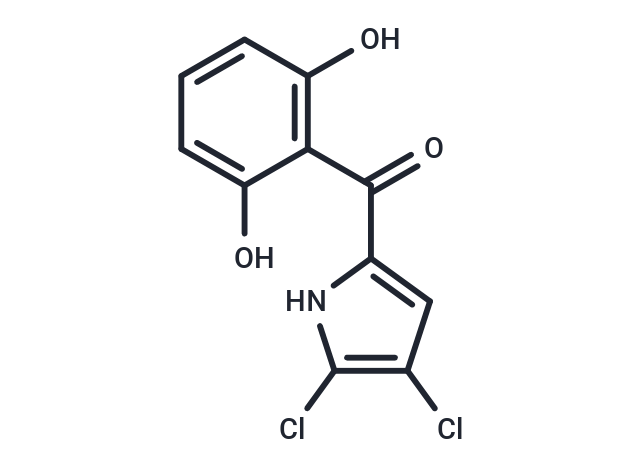
Pyoluteorin
CAS No. 25683-07-2
Pyoluteorin( —— )
Catalog No. M33757 CAS No. 25683-07-2
Pyoluteorin is an antibiotic that inhibits Oomycete fungi, including the plant pathogen Pythium ultimum, and suppresses related plant diseases.
Purity : >98% (HPLC)
 COA
Datasheet
HNMR
HPLC
MSDS
Handing Instructions
COA
Datasheet
HNMR
HPLC
MSDS
Handing Instructions
| Size | Price / USD | Stock | Quantity |
| 2MG | 299 | Get Quote |


|
| 5MG | 472 | Get Quote |
|
| 10MG | 658 | Get Quote |
|
| 25MG | 994 | Get Quote |
|
| 50MG | 1334 | Get Quote |
|
| 100MG | 1764 | Get Quote |
|
| 500MG | 3537 | Get Quote |
|
| 1G | Get Quote | Get Quote |
|
Biological Information
-
Product NamePyoluteorin
-
NoteResearch use only, not for human use.
-
Brief DescriptionPyoluteorin is an antibiotic that inhibits Oomycete fungi, including the plant pathogen Pythium ultimum, and suppresses related plant diseases.
-
DescriptionPyoluteorin is an antibiotic that inhibits Oomycete fungi, including the plant pathogen Pythium ultimum, and suppresses plant diseases caused by this fungus. Pyoluteorin induces human triple-negative breast cancer MDA-MB-231 cells apoptosis in vitro. Pyoluteorin can be used for the research of human triple-negative breast cancer.
-
In VitroPyoluteorin is an antifungal compound composed of a bichlorinated pyrrole linked to a resorcinol moiety, were identified within a 24-kb genomic region of Pseudomonas fluorescens Pf-5.Pyoluteorin has significant cytotoxicity towards MCF-7 (IC50=1.84 μM). Pyoluteorin also displays significantly selective cytotoxicity against BT474, HCC1954, MAD-MB-468, MDA-MB-231, and MCF-10A cells with IC50s of 9.75±0.16, 0.94±0.01, 3.89±0.08, 0.97±0.01, and 57.01±0.76 μM, respectively.Pyoluteorin (0.1-10 μM; for 24 hours) induces change of apoptosis-related protein expressions. Pyoluteorin-induced cell apoptosis in MDA-MB-231 is related to Bcl-2 family proteins and caspase cascade.Pyoluteorin (0.1-10 μM; for 24 h) induces cell cycle arrest and apoptosis in human triple-negative breast cancer cells MDA-MB-231.Cell Proliferation Assay Cell Line:Human triple-negative breast cancer cell MDA-MB-231 Concentration:0, 0.032, 0.16, 0.8, 4, 20, 100 μM Incubation Time:24, 48, 72 hours Result:Inhibited cells proliferation in a dose- and time-dependent manner. Western Blot Analysis Cell Line:MDA-MB-231 cells Concentration:0.1, 0.3, 1, 3, 10 μM Incubation Time:24 hours Result:The levels of the anti-apoptotic proteins Bcl-2, Bcl-XL and PARP were obviously decreased while the pro-apoptotic proteins BAX and caspase 3 were increased in a dose-dependent manner.
-
In Vivo——
-
Synonyms——
-
PathwayMicrobiology/Virology
-
TargetAntibiotic
-
RecptorAntibiotic
-
Research Area——
-
Indication——
Chemical Information
-
CAS Number25683-07-2
-
Formula Weight272.08
-
Molecular FormulaC11H7Cl2NO3
-
Purity>98% (HPLC)
-
Solubility——
-
SMILESOc1cccc(O)c1C(=O)c1cc(Cl)c(Cl)[nH]1
-
Chemical Name——
Shipping & Storage Information
-
Storage(-20℃)
-
ShippingWith Ice Pack
-
Stability≥ 2 years
Reference
1. B Nowak-Thompson, et al. Characterization of the pyoluteorin biosynthetic gene cluster of Pseudomonas fluorescens Pf-5. J Bacteriol. 1999 Apr;181(7):2166-74.?
molnova catalog



related products
-
Diethylamine NONOate...
Diethylamine NONOate diethylammonium salt (DEA NONOate diethylamine) is a nitric oxide donor with antibacterial activity, a dispersant for preformed biofilms of Pseudomonas aeruginosa and inhibits the growth of E. coli.
-
Moxipraquine
Moxipraquine is a novel 8-aminoquinolone compound with anti-infective activity against Trypanosoma cruzi. Moxipraquine effectively inhibited parasitemia but did not eradicate infections in mice or guinea pigs.
-
Tilmicosin phosphate
Tilmicosin phosphate, a macrolide antibiotic, is used to treat cattle for pathogens that cause Bovine Respiratory Disease.
