


 Cart
Cart
 sales@molnova.com


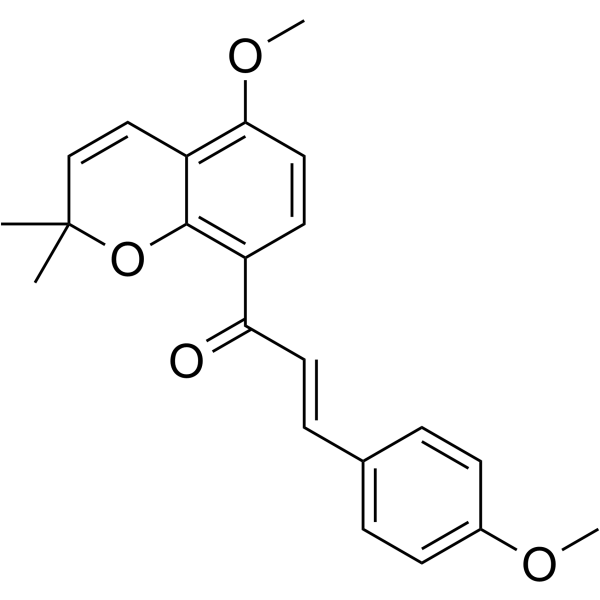
Millepachine
CAS No. 1393922-01-4
Millepachine( —— )
Catalog No. M28201 CAS No. 1393922-01-4
Millepachine is a natural product found in the Chinese herbal medicine with strong antitumor effects against numerous human cancer cells.
Purity : >98% (HPLC)
 COA
Datasheet
HNMR
HPLC
MSDS
Handing Instructions
COA
Datasheet
HNMR
HPLC
MSDS
Handing Instructions
| Size | Price / USD | Stock | Quantity |
| 5MG | 177 | Get Quote |


|
| 10MG | 295 | Get Quote |
|
| 25MG | 502 | Get Quote |
|
| 50MG | 709 | Get Quote |
|
| 100MG | 1008 | Get Quote |
|
| 200MG | Get Quote | Get Quote |
|
| 500MG | Get Quote | Get Quote |
|
| 1G | Get Quote | Get Quote |
|
Biological Information
-
Product NameMillepachine
-
NoteResearch use only, not for human use.
-
Brief DescriptionMillepachine is a natural product found in the Chinese herbal medicine with strong antitumor effects against numerous human cancer cells.
-
DescriptionMillepachine is a natural product found in the Chinese herbal medicine with strong antitumor effects against numerous human cancer cells.(In Vitro):Millepachine (2-8 μM; 24 h) inhibits ATP-binding cassette transporter activity in A2780CP cells. Millepachine (2-8 μM; 24 or 48 h) induces significant G2/M arrest and apoptosis of cisplatin-sensitive A2780S and cisplatin-resistant A2780CP cells. The percentage of cells in the G2/M fraction increased from 15.99% in vehicle cells to 24.93%, 60.67%, and 77.31% at dose of 2, 4, and 8 μM in A2780S cells, respectively. Millepachine (2-8 μM; 24 h) decreases topoisomerase II levels in A2780S and A2780CP cells. Millepachine (1.25-20 μM; 48 h) remarkably inhibits the proliferation of cisplatin-resistant A2780CP cells with an IC50 of 4 μM.(In Vivo):Millepachine (20 mg/kg; i.v.) reduced tumor volume and tumor weight with the inhibitory rate of 73.21% and 65.58% in A2780S and A2780CP xenograft models, respectively. Millepachine does not induce acquired drug resistance in an excised A2780S xenograft model.
-
In VitroMillepachine (1.25-20 μM; 48 h) remarkably inhibits the proliferation of cisplatin-resistant A2780CP cells.Millepachine (2-8 μM; 24 or 48 h) induces G2/M arrest and apoptosis cisplatin-sensitive A2780S and cisplatin-resistant A2780CP cells.Millepachine (2-8 μM; 24 h) decreases topoisomerase II levels in A2780S and A2780CP cells.Millepachine (2-8 μM; 24 h) inhibits ATP-binding cassette transporter activity in A2780CP cells.Cell Proliferation Assay Cell Line:A2780CP cells Concentration:0, 1.25, 2.5, 5, 10, 20 μM Incubation Time:48 hours Result:Inhibited the cells proliferation with an IC50 of 4 μM.Cell Cycle Analysis Cell Line:A2780S and A2780CP cells Concentration:2, 4, 8 μM Incubation Time:24 or 48 hours Result:Induced significant G2/M arrest both in both cells.The percentage of cells in the G2/M fraction increased from 15.99% in vehicle cells to 24.93%, 60.67%, and 77.31% at dose of 2, 4, and 8 μM in A2780S cells, respectively.Apoptosis Analysis Cell Line:A2780S and A2780CP cells Concentration:2, 4, 8 μM Incubation Time:24 or 48 hours Result:The percentage of apoptotic cells increased from 1.49% in vehicle cells to 10.98%, 20.60%, and 39.43% at dose of 2, 4, and 8 μM in A2780S cells, respectively.The percentage of apoptotic cells increased from 0.87% to 10.97%, 25.28%, and 37.59% in A2780CP cells, respectively.Western Blot Analysis Cell Line:A2780S and A2780CP cells Concentration:0, 2, 4, 8 μM Incubation Time:24 hours Result:Decreased the levels of topoisomerase II (TOPO II) in both cells.
-
In VivoMillepachine (20 mg/kg; i.v. every two days for 14 day) inhibits tumor growth in mice.Millepachine (20 mg/kg; i.v. every two days for 14 day) does not induce acquired drug resistance in an excised A2780S xenograft model. Animal Model:Female BALB/c nude mice (6 weeks) are injected A2780S or A2780CP cells Dosage:20 mg/kg Administration:I.v. every two days for 2-14 days Result:Reduced tumor volume and tumor weight with the inhibitory rate of 73.21% and 65.58% in A2780S (after seven times injection) and A2780CP (after six times injection) xenograft model, respectively.
-
Synonyms——
-
PathwayApoptosis
-
TargetApoptosis
-
RecptorNO
-
Research Area——
-
Indication——
Chemical Information
-
CAS Number1393922-01-4
-
Formula Weight350.41
-
Molecular FormulaC22H22O4
-
Purity>98% (HPLC)
-
SolubilityIn Vitro:?DMSO : 100 mg/mL (285.38 mM)
-
SMILESCC(C)(C=Cc1c(cc2)OC)Oc1c2C(/C=C/c(cc1)ccc1OC)=O
-
Chemical Name——
Shipping & Storage Information
-
Storage(-20℃)
-
ShippingWith Ice Pack
-
Stability≥ 2 years
Reference
1.KUBO, MICHINORI, et al. Scutellariae radix. X. Inhibitory effects of various flavonoids on histamine release from rat peritoneal mast cells in vitro. Chem. Pharm. Bull., 1984, 32(12):5051-4.
molnova catalog



related products
-
Exisulind
Exisulind induces apoptosis through the activation of protein kinase G (PKG). Exisulind exhibits antineoplastic activity in solid tumour and haematological cancer cell lines and is an inhibitor of tumour growth in rodent models of colon, prostate, bladder, mammary and lung cancer.
-
CTA 056
CTA 056 is an interleukin-2 induced T cell kinase (ITK) inhibitor, inhibits the growth of MOLT-4 xenograft tumors in mice, induces apoptosis in Jurkat cells, and can be used in the study of autoimmune disorders and T cell malignancies.
-
VTP50469
VTP50469 is a highly selective and orally active inhibitor of Menin-MLL interaction( Ki: 104 pM) and has potently anti-leukemia activity.
