


 Cart
Cart
 sales@molnova.com


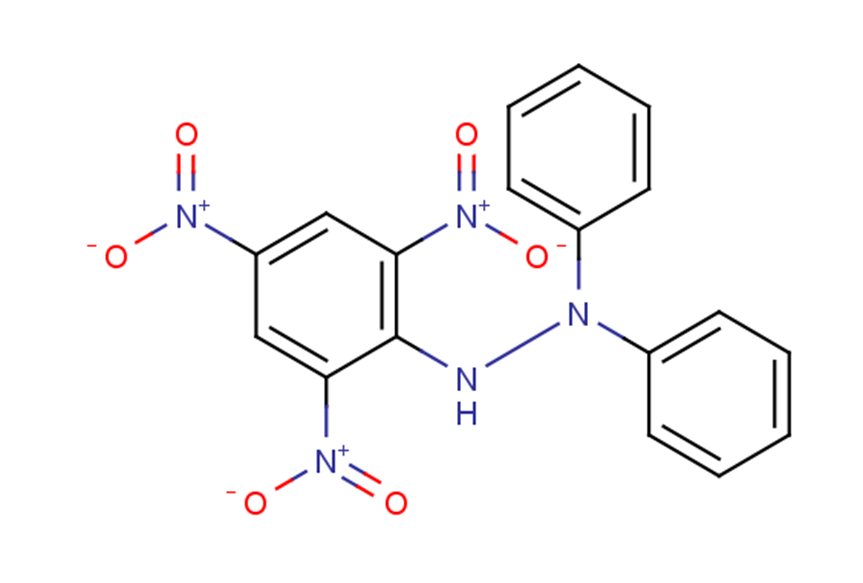
DPPH
CAS No. 1898-66-4
DPPH( 2,2-Diphenyl-1-picrylhydrazyl )
Catalog No. M22612 CAS No. 1898-66-4
DPPH is a cell-permeable, stable free radical that is commonly used to evaluate the ability of compounds to act as free radical scavengers or hydrogen donors and to measure the antioxidant activity of tissue extractsDPPH shows a strong absorption band at 517nm.
Purity : >98% (HPLC)
 COA
Datasheet
HNMR
HPLC
MSDS
Handing Instructions
COA
Datasheet
HNMR
HPLC
MSDS
Handing Instructions
| Size | Price / USD | Stock | Quantity |
| 1 mL x 10 mM in DMSO | 29 | In Stock |


|
| 25MG | 29 | In Stock |
|
| 50MG | 37 | In Stock |
|
| 100MG | 58 | In Stock |
|
| 200MG | Get Quote | In Stock |
|
| 500MG | 140 | In Stock |
|
| 1G | Get Quote | In Stock |
|
Biological Information
-
Product NameDPPH
-
NoteResearch use only, not for human use.
-
Brief DescriptionDPPH is a cell-permeable, stable free radical that is commonly used to evaluate the ability of compounds to act as free radical scavengers or hydrogen donors and to measure the antioxidant activity of tissue extractsDPPH shows a strong absorption band at 517nm.
-
DescriptionDPPH is a cell-permeable, stable free radical that is commonly used to evaluate the ability of compounds to act as free radical scavengers or hydrogen donors and to measure the antioxidant activity of tissue extractsDPPH shows a strong absorption band at 517nm. Due to its odd number of electrons, the solution presents a dark purple color, and the absorption disappears as the electron pairs are detached.The resulting decoloration is stoichiometric and depends on the number of electrons absorbed.Alcohol solutions of 0.5 mM are dense in color, and at this concentration, the Lambert-Beer law is followed within the effective range of absorption.DPPH is a fast, simple, inexpensive and widely used method for determining the ability of compounds to act as free radical scavengers or hydrogen donors and for evaluating the antioxidant activity of foods.It can also be used to quantify antioxidants in complex biological systems, solid or liquid samples.The method was simple and easy to determine the total antioxidant capacity and free radical scavenging activity of fruit and vegetable juice.The antioxidant properties of wheat grains and bran, vegetables, conjugated linoleic acid, herbal medicine, edible seed oil and flour in ethanol, acetone, methanol, ethanol and benzene were successfully studied.It is a simple method for the determination of the antioxidant properties of cysteine, glutathione, ascorbic acid, tocopherol and polyhydroxyaromatic compounds in olive oil, fruits, fruit juices and wines.
-
In Vitro——
-
In Vivo——
-
Synonyms2,2-Diphenyl-1-picrylhydrazyl
-
PathwayOthers
-
TargetOther Targets
-
RecptorOthers
-
Research Area——
-
Indication——
Chemical Information
-
CAS Number1898-66-4
-
Formula Weight394.32
-
Molecular FormulaC18H12N5O6
-
Purity>98% (HPLC)
-
SolubilityDMSO:24 mg/mL (60.86 mM; Need ultrasonic)
-
SMILES[O-][N+](=O)c1cc(c(NN(c2ccccc2)c2ccccc2)c(c1)[N+]([O-])=O)[N+]([O-])=O
-
Chemical Name——
Shipping & Storage Information
-
Storage(-20℃)
-
ShippingWith Ice Pack
-
Stability≥ 2 years
Reference
1. Kedare SB, et al. Genesis and development of DPPH method of antioxidant assay. J Food Sci Technol. 2011 Aug;48(4):412-22.
molnova catalog



related products
-
1,2-Distearoyl-sn-gl...
L-ALPHA-PHOSPHATIDYLCHOLINE, DISTEAROYL is a cylindrical-shaped lipid used to synthesize liposomes. L-ALPHA-PHOSPHATIDYLCHOLINE, DISTEAROYL is the lipid component in the lipid nanoparticle (LNP) system.
-
Prolactin-Releasing ...
Prolactin-Releasing Peptide (1-31) (rat) is a UHR-1/GRP10 receptor ligand. Prolactin-Releasing Peptide (1-31) (rat) reduces fasting-induced food intake, increases plasma levels of LH, FSH, and testosterone in rats.
-
BGB 15025
HPK1-IN-32 is a potent and selective HPK1 inhibitor with an IC50 of 65 nM. HPK1-IN-32 can be used for the research of HPK1 related disorders or diseases.
